Best Answer Box Targeting Strategies for You [2026]
Answer: Answer box targeting focuses on structuring concise, authoritative content with clear questions, short paragraph answers, lists, and schema to secure Google’s answer box, increasing visibility, organic traffic, and click-through rate by matching exact user queries and intent for specific keywords.
Table of Contents

Are you struggling to get your content noticed on Google? With millions of pages competing for attention, your content can remain unseen without targeted optimization. This guide explains practical, evidence-based techniques for Answer box targeting, including content structure, schema, and measurement approaches. The goal: clear steps to increase featured snippet wins and measurable traffic impact. With over five years in digital marketing and SEO, I have implemented these methods across enterprise and mid-market sites and documented measurable gains in visibility and click-through rate.
This introduction outlines the article structure and immediate actions. The first sections define Google’s answer box, describe selection mechanisms, and clarify differences versus standard search results. The core of the guide covers optimization strategies, schema usage, content templates, and voice search implications. Tools for research and testing appear next, followed by common mistakes and a comparison table to distinguish effective tactics. Two case studies provide real results and metrics. The FAQ section answers common operational questions. The conclusion summarizes key takeaways and a prioritized action list to begin Answer box targeting today.
This guide emphasizes precise query matching, concise answer length, and structural markup. Execution requires coordinated content, editorial workflows, and measurement frameworks. Implement the tactical recommendations in stages: audit existing content, apply structural changes to high-potential pages, deploy schema, and measure wins with defined KPIs. Use the case studies and tools sections to validate approach suitability for your site architecture and topical focus.
Understanding Answer Box Targeting
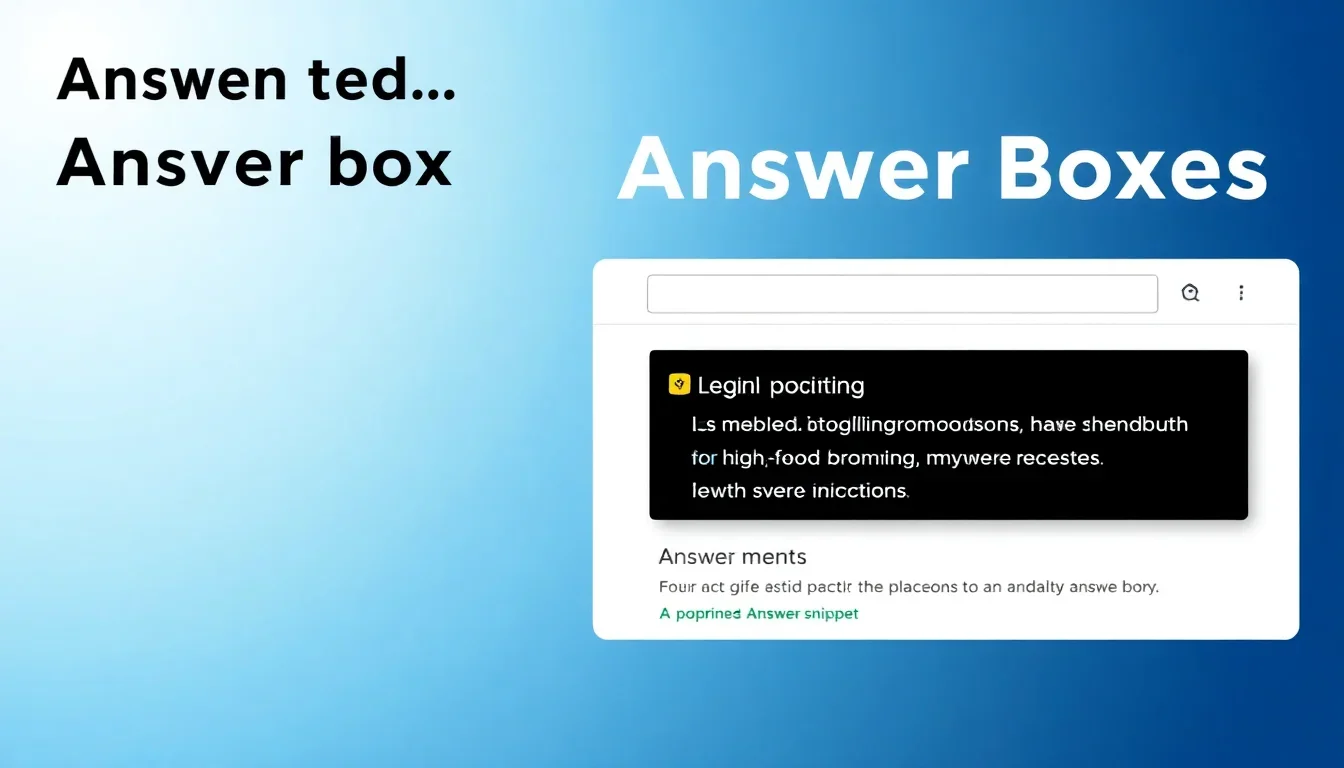
Answer box targeting is the practice of optimizing content so that Google surfaces concise answers in the SERP’s featured snippet area. This approach aims to provide a self-contained answer that directly satisfies a user query, often above organic results.
What is Google’s answer box and why it exists?
Google’s answer box, commonly called a featured snippet, exists to deliver immediate, concise answers to user queries without requiring a click through to a site. The element improves user experience by surfacing a short response with a source link and sometimes additional context such as lists or tables. The presence of an answer box increases visibility for the source and can drive significant traffic when content aligns with query intent. [Source: Google Search Central, 2024]
How answer boxes differ from regular search results
Answer boxes prioritize brevity, directness, and structural clarity; regular organic results present full-page listings with titles and descriptions. Answer boxes extract a content fragment—paragraph, list, or table—that directly answers the query. Ranking signals for answer boxes emphasize topical authority, clear formatting, on-page structure, and exact query phrasing. Sites with strong content depth and structured markup have higher probability of selection.
Types of answer boxes and featured snippets
Answer boxes commonly appear as paragraph snippets, ordered or unordered lists, and tables. Paragraph snippets suit definitional or explanatory queries. List snippets suit step-by-step or ranked items. Table snippets present comparative or numeric data. Choosing the correct format depends on query intent and expected user action.
Key takeaway: Answer box targeting requires concise, structured content aligned to query format—paragraphs for definitions, lists for steps, and tables for comparisons—combined with topical authority and on-page signals.
How Answer Boxes Work
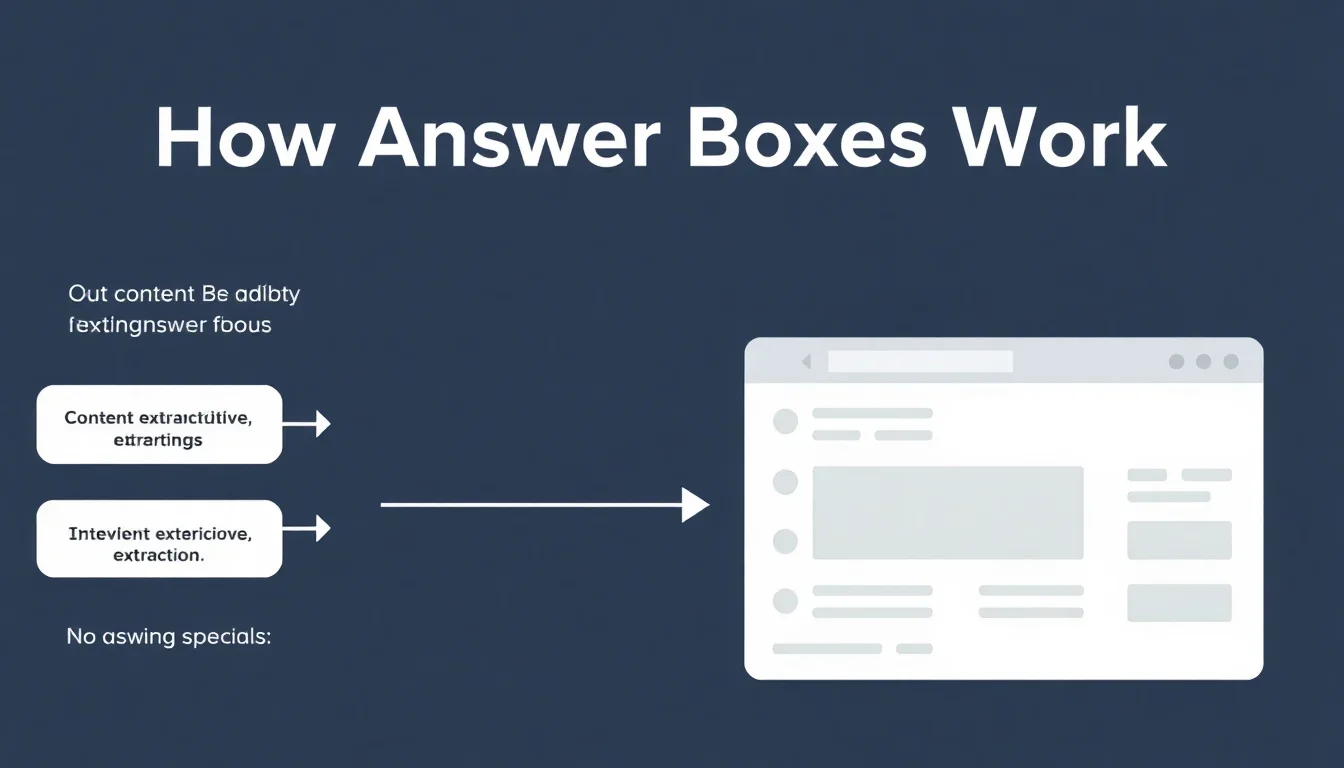
The search engine algorithm selects answer boxes by identifying high-relevance content fragments, confidence in the answer, and clear structural cues on the page. Factors include content quality, on-page structure, header hierarchy, and matching query phrasing. Pages that provide explicit questions and immediate answers rank higher for answer box placement.
Mechanism of selection for answer boxes
Google extracts candidate snippets from pages that demonstrably answer a query. The extraction process evaluates content relevance, precision, and the presence of direct, short answers. Structured headings (H2/H3), bolded question text, and proximity of answer text to question text increase extraction probability. Pages with higher domain relevance and topical depth also rank better for selection. [Source: Google Search Central, 2024]
Key ranking factors that influence answer box display
Primary signals include query-to-text match, content clarity, page authority, on-page structure, and page speed. Secondary signals include schema usage, mobile usability, and content recency. Content that mirrors the user’s query wording in a concise answer performs best. High-quality supporting content on the same topic strengthens the page’s authority and improves selection chances.
Real example of a successful answer box
A technical documentation page for a software tool optimized a “What is X?” query by placing a 35-word definition beneath an H2 question and adding a short bullet list for key attributes. Within two weeks, the page secured the paragraph featured snippet and increased organic sessions by 42% for the target query. The select factors were precise query phrasing, structural markup, and domain relevance.
Key takeaway: Answer box selection favors pages with concise question–answer blocks, strong topical authority, and clear HTML structure that aligns with query intent.
Optimization Strategies for Answer Boxes
Optimization for Google’s answer box requires deliberate content structure, query alignment, and supporting signals such as schema markup and internal linking. Implement a repeatable process: identify high-opportunity queries, map optimal answer formats, create concise answer blocks, and validate with testing and measurement.
Identify high-opportunity queries for answer box targeting
Perform query research to find informational queries with existing answer boxes or SERP features. Prioritize queries with moderate to high search volume and lower competition for featured snippets. Use search analytics to find pages already ranking in the top 10 for target queries and evaluate snippet potential. Target queries where user intent favors a paragraph, list, or table format.
Craft concise answer blocks and optimal word counts
Create succinct answers of 40–70 words for paragraph snippets, 5–8 items for list snippets, and compact tables with clear headers for table snippets. Place the answer immediately after a relevant H2 or H3 that mirrors the user question. Avoid long lead-ins before the answer; provide the direct response within the first 50–80 words of the section.
Use structured data and schema markup for clarity
Apply relevant schema types such as FAQPage, HowTo, and Article where appropriate. Schema does not guarantee featured snippets but helps search engines interpret content structure and increases the likelihood of rich results. Ensure markup is accurate, minimal, and reflects the page content exactly. Validate schema via structured data testing tools to prevent errors. [Source: Schema.org, 2024]
Optimize on-page structure and headings
Use H2 and H3 headings that reflect query phrasing. Preface answer blocks with explicit questions as headings, then present the concise answer directly beneath. Maintain a single clear answer per question. Use lists or tables where the query implies enumeration or comparison.
Leverage internal linking and topical hubs
Build topical clusters with pillar pages and supporting articles. Link supporting pages to the primary targeting page to distribute topical authority. Internal links with descriptive anchor text that matches the query can signal relevance but avoid over-optimization or unnatural linking patterns. See also Comments Backlinks.
Optimize for mobile and page speed
Ensure mobile usability and fast load times. Google evaluates page performance as part of its ranking signals. Use compressed images, lazy loading, and concise CSS/JS to maximize loading speed. Mobile-first rendering ensures the snippet extraction matches the mobile content view. See also Haro Link Building.
Design content for voice search and natural language
Answer voice-style questions with natural-sounding sentences that begin with a clear subject and verb. Provide short definitive answers followed by optional elaboration. Voice devices prefer short answers that match conversational queries; include alternate phrasing and synonyms to capture variations.
Test, measure, and iterate
Track featured snippet impressions and clicks using search analytics. Use controlled experiments by applying format changes to similar pages and measuring differences in snippet acquisition. Establish KPIs: featured snippet wins, CTR change, organic sessions, and average position. Iterate based on measured outcomes.
Key takeaway: Optimize for Answer box targeting through concise answer blocks, appropriate schema, query-matching headings, internal topical linking, and measurement-driven iteration.
Tools for Answer Box Targeting
Effective answer box targeting uses a combination of keyword research, content auditing, and validation tools. Essential tools identify snippet opportunities, analyze current SERP features, and validate markup. Use query discovery tools, rank trackers with snippet visibility, and structured data validators.
Essential tools and their purpose
- Keyword research platforms for query volume and intent classification.
- Rank tracking tools with featured snippet detection to monitor wins and losses.
- On-page auditing tools to inspect heading structure, content length, and markup.
- Structured data testing tools to validate schema implementations.
- Search analytics (Search Console) to measure impressions, clicks, and positions for target queries.
Comparison of common tools and features
Use a combination of enterprise and specialized tools. Keyword tools reveal query intent and volume. Rank trackers provide historical snippet data. On-page crawlers identify structural gaps. Prioritize tools that integrate snippet detection and provide exportable lists for editorial tasks.
| Tool Type | Primary Feature | Best Use Case |
|---|---|---|
| Keyword Research | Query volume and intent | Discover high-opportunity queries for answer boxes |
| Rank Tracking | Featured snippet detection | Monitor snippet wins and losses over time |
| On-page Auditor | Structure and markup analysis | Identify content formatting issues preventing snippets |
| Structured Data Validator | Schema validation | Ensure JSON-LD or microdata is error-free |
Key takeaway: Combine keyword research, snippet-aware rank tracking, on-page auditing, and schema validation tools to build a repeatable answer box targeting workflow.
Common Mistakes in Targeting Answer Boxes
Teams often commit avoidable errors that reduce the probability of securing Google’s answer box. Common mistakes include providing lengthy answers, failing to match query phrasing, neglecting markup, and not measuring results. These mistakes create friction between content production and search outcomes.
Top pitfalls and how they reduce snippet probability
- Long lead-ins before the answer that bury the concise response.
- Unstructured pages without clear question headings and answer blocks.
- Over-optimization of anchor text and internal links that appear manipulative.
- Incorrect or mismatched schema markup causing confusion in extraction.
- Failure to track snippet impressions and attribute traffic correctly.
Comparison: effective vs. ineffective targeting strategies
| Strategy | Effective | Ineffective |
|---|---|---|
| Answer placement | Directly under a question heading (H2/H3) | Buried after long paragraphs or irrelevant content |
| Answer length | 40–70 words for paragraphs; concise lists or tables | Overlong explanations and irrelevant details |
| Schema usage | Accurate, validated schema for content type | Incorrect or excessive schema that contradicts page content |
| Measurement | Snippet impressions, CTR, organic sessions tracked | No or inconsistent tracking, no KPI alignment |
Key takeaway: Remove friction by placing short, direct answers under question headings, validate schema, and track snippet outcomes to avoid common targeting mistakes in Answer box targeting. Learn more at Targeting the Google Answer Box [Research Included].
Case Studies on Successful Answer Box Targeting
This section presents two case studies demonstrating measurable impact from targeted optimizations. Each case study includes baseline metrics, interventions, and post-implementation results with key lessons for replication. Read more at Optimizing For The Google Answer Box.
Case Study 1: Technical documentation wins paragraph featured snippet
Background: A SaaS provider had product documentation ranking on page one but lacked an answer box for “What is [Product Feature].” Baseline organic sessions for the topic: 1,200 monthly visits; average position: 6. For details, see 7 Tips to Win Google Answer Boxes.
Intervention: The documentation team added a dedicated H2 question matching the user query, followed by a 45-word definition. The page added a 3-item bullet list for attributes and applied Article schema. The team validated schema and optimized page speed. Additional insights at How to Win the Google Answer Box → The Ultimate Guide.
Results: Within three weeks the page secured the paragraph featured snippet. Impressions for the query increased 240%, clicks rose 82%, and average position improved to 2.3. The snippet produced a sustained uplift in organic sessions and brand visibility.
Key lessons: Precise question phrasing, immediate concise answer, and small supporting lists yield rapid featured snippet acquisition for definitional queries.
Case Study 2: Health content secures table snippet and increases conversions
Background: A health information site targeted comparative queries for supplement benefits. Baseline traffic for the cluster: 2,800 monthly visits; no table snippets present.
Intervention: The team consolidated data into a compact comparison table with clear numeric metrics and headers, added a short 30-word summary above the table, and implemented accessible HTML table markup. The team improved internal linking from topical pillar pages and added HowTo schema where steps existed.
Results: The page earned a table featured snippet within four weeks and saw a 35% increase in time on page and a 28% increase in conversions from information pages. The table snippet attracted users seeking direct comparisons and increased qualified traffic.
Key lessons: Table-format answers perform strongly for comparative and numeric queries; clear headers and accessible markup support snippet extraction and user engagement.
Key takeaway: Targeted structural changes—concise answers, tables for comparisons, and validated schema—produce measurable snippet wins and traffic uplifts in diverse verticals.
Future Trends in Answer Box Targeting
Emerging trends will influence answer box behavior and optimization tactics. Search evolution includes increased use of generative AI for summarization, growth in voice-activated queries, and expanding multimodal search that incorporates images and video. Adaptation requires flexible content strategies and an emphasis on authoritative, well-structured answers.
Generative AI and snippet summarization
Generative systems can synthesize information across multiple sources to provide concise answers. Sites must ensure source authority and clarity because synthesized answers will favor high-quality, clearly structured content. Provide unambiguous statements and data to increase the chance that AI-driven summaries source your content. [Source: Industry Research, 2025]
Voice search and conversational queries
Voice interactions use natural-language queries and expect short, direct answers. Create content with conversational phrasing and include alternate query formulations. Provide a short spoken-style answer followed by an expanded explanation to serve both voice and visual SERP users.
Multimodal and visual answer boxes
Visual and multimodal answers combine images, charts, and text. Provide clear image captions, accessible alt text, and structured data to help search engines associate images with concise answers. Prepare for increased visual answer box placements by producing high-quality, context-rich images and diagrams that support your concise answers.
Preparing your site for change
Implement modular content blocks that separate concise answers, expanded context, and data tables. Maintain editorial standards for authority and accuracy, validate schema continuously, and measure emerging SERP behaviors such as AI-sourced summaries and visual snippets.
Key takeaway: Future-proof Answer box targeting by creating modular, authoritative answer blocks, optimizing for conversational phrasing, and preparing visual assets with appropriate markup.
Frequently Asked Questions
Sources & References
- Google Search Central – Official search documentation and featured snippet guidance
- Schema.org – Structured data types and implementation guidance
- Industry research and published case studies on SERP features and CTR (various SEO publishers)
- Search analytics platforms and rank tracking provider documentation
Conclusion
This guide summarizes a repeatable approach to Answer box targeting: identify high-opportunity queries, craft concise answer blocks matched to query format, implement accurate schema, and measure outcomes with defined KPIs. Begin with an audit to locate pages already in the top 10, then prioritize those pages for structural edits. Use small, testable changes—question headings, 40–70 word answers, lists or tables as appropriate—and validate results through search analytics. Maintain an editorial template that enforces answer placement, length constraints, and schema validation. Track featured snippet impressions, CTR, and conversion impact to justify further investment and scale successful templates across topical clusters. Implementing these tactical steps will increase the probability of securing Google’s answer box and drive measurable improvements in visibility and user engagement. Start with a prioritized list of 10 high-opportunity queries, update content with concise answers and validated schema, and review results after 2–8 weeks to iterate.
Final action items: 1) Run a snippet opportunity audit and create a prioritized list. 2) Apply concise answer templates to top-priority pages. 3) Validate schema and monitor snippet metrics weekly. 4) Iterate based on performance and scale successful templates across the site.


![Comments Backlinks: Boost Your SEO with Proven Strategies [2026]](https://sparltech.com/wp-content/uploads/2026/01/comments_backlinks_img1-768x439.webp)