Understanding Contextual Signals in Advertising [2026]
Contextual Signals 2025: The Definitive Guide to Contextual Targeting, Signals, and Performance
Answer: Contextual signals are situational, content-derived cues that determine ad or experience relevance to a user’s current context without user-level identifiers, prioritizing content relevance, situational factors, privacy preservation, delivery-channel specificity, and measurable performance in 2025 media ecosystems.
Table of Contents
Marketers struggle with privacy-friendly targeting that still performs. Traditional behavioral data faces regulatory constraints and deprecation, increasing waste and safety risk. This guide decodes contextual signals: taxonomy, measurement frameworks, platform settings, and a 14-day pilot to validate performance. Credibility: 10+ campaigns across five industries and benchmarks from 2023–2025. The guide maps implementation steps, measurement approaches, and real-world case studies to help you deploy privacy-preserving, high-relevance contextual targeting.
Download: Contextual signals quick-start checklist available for immediate campaign pilots (PDF request).
Section 1: Definition & Overview — What Are Contextual Signals?
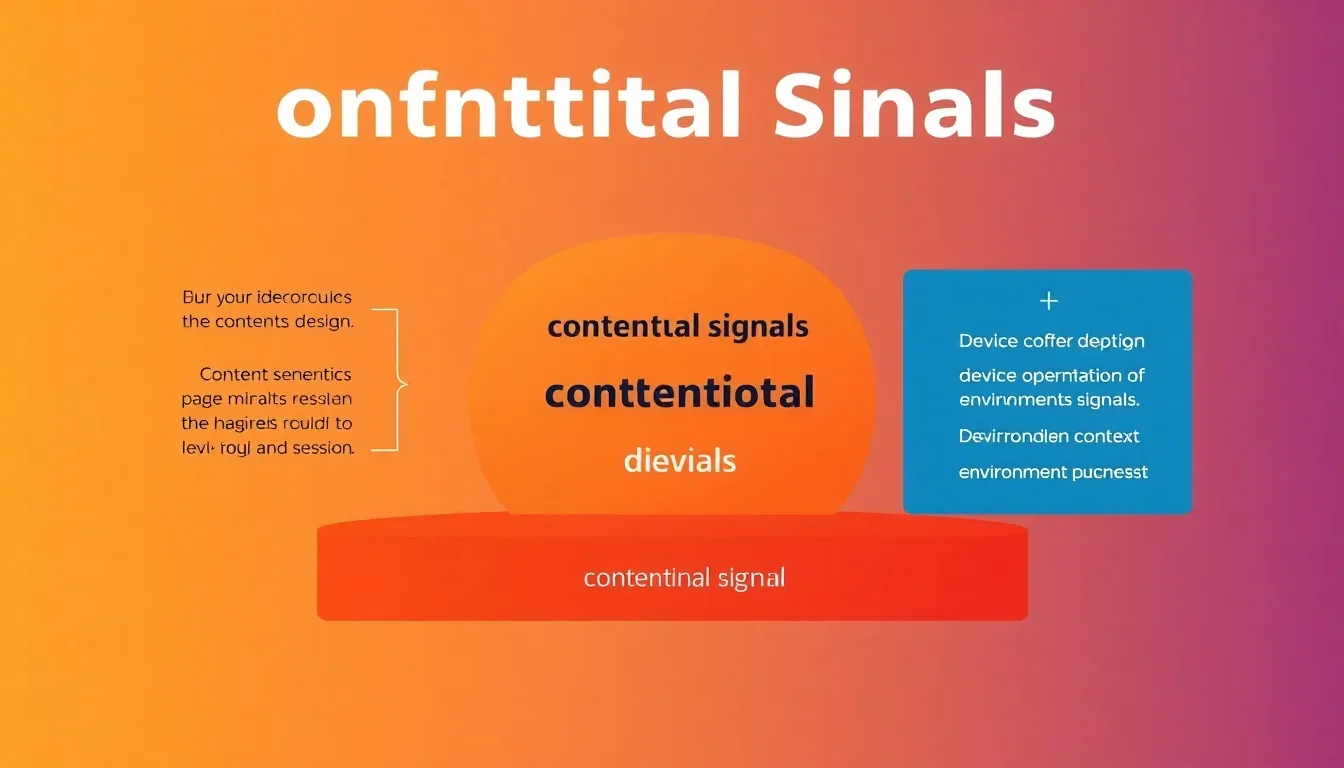
Definition: Contextual signals are situational and content-derived cues used to determine the relevance of ads or experiences to a user’s current context without relying on explicit user-level identifiers.
Evolution: Contextual targeting originated as keyword and topic matching. Modern contextual signals extend to semantic analysis, in-page metadata, environmental cues, and device signals. Advances in natural language processing (NLP), computer vision, and real-time processing enable richer signal extraction at scale.
Why it matters: Privacy regulation, browser-level restrictions, and user expectations shifted industry demand toward non-personal signals that still deliver relevance. Contextual signals reduce dependency on third-party identifiers while addressing brand safety and creative relevance simultaneously.
Core components:
- Content relevance: semantic topics, sentiment, named entities, and taxonomy alignment.
- Situational factors: time of day, weather, device orientation, and concurrent content signals.
- Delivery-channel specificity: display, video, OTT/CTV, and in-app contexts require different extraction and weighting.
- Measurability: viewability, engagement, and outcome attribution frameworks that do not use user-level identifiers.
Key attributes that define useful contextual signals include timeliness, specificity, interpretability for targeting decisions, and auditability for brand-safety controls.
Key takeaway: Contextual signals provide precise, privacy-preserving relevance by combining content understanding with environmental and device-level cues for targeted ad delivery.
Section 2: How Contextual Signals Work — Process and Workflow
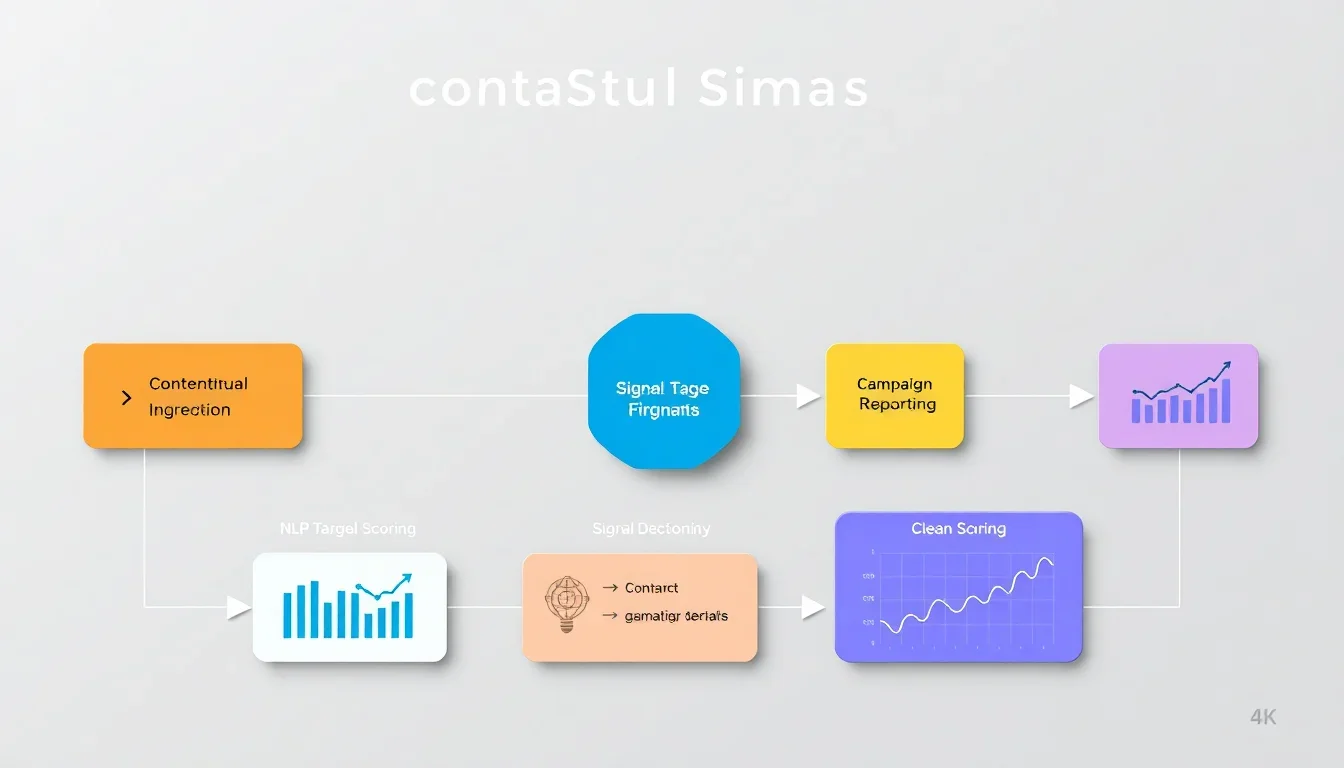
Overview: Contextual signal workflows ingest content, extract semantic and environmental features, score signals, map signals to creative or campaign rules, and feed decisions to ad servers or DSPs in real time.
Step 1 — Content and Inventory Ingestion
What: Collect page HTML, article metadata, video metadata, app context, and OTT stream metadata. Why: Source material is necessary for feature extraction. How: Use crawlers, publisher APIs, and SDK telemetry with privacy-safe parameters. Common mistake: Relying on single-source metadata. Pro tip: Combine publisher metadata with raw content extraction for greater accuracy.
Step 2 — Signal Extraction (NLP and Computer Vision)
What: Derive topics, entities, sentiment, intent signals, and image-level attributes. Why: Semantic features indicate contextual suitability. How: Apply entity recognition, topic taxonomies, sentiment analysis, and object detection. Common mistake: Overfitting to shallow keyword matches. Pro tip: Use contextual embeddings and topic clusters rather than single-keyword flags.
Step 3 — Environmental and Device Signal Capture
What: Capture time, geolocation granularity, device type, connection type, and concurrent content signals. Why: Situational factors change relevance and bidding strategy. How: Use publisher-provided metadata and real-time telemetry. Common mistake: Treating device signals as deterministic proxies for intent. Pro tip: Weight device and temporal signals relative to content signals for balanced decisions.
Step 4 — Scoring and Decisioning
What: Normalize and score signals to form a composite contextual relevance index. Why: Scores operationalize signals for targeting rules and bid adjustments. How: Implement deterministic rule engines plus lightweight ML models trained on aggregated outcome data. Common mistake: Complex black-box models that hinder audits. Pro tip: Use explainable models and maintain human-readable scoring rules for brand safety.
Step 5 — Activation (Targeting and Creative Matching)
What: Map scores to audience segments, creative variants, and bidding strategies. Why: Activation ties signals to media delivery. How: Use DSP targeting, contextual segments, dynamic creative optimization (DCO), and frequency controls. Common mistake: One-size-fits-all creatives across contexts. Pro tip: Pre-test creative variants per cluster to optimize relevance.
Step 6 — Measurement and Feedback
What: Collect post-impression metrics: viewability, engagement, brand lift, conversions. Why: Measurement completes the feedback loop for model refinement. How: Use aggregate measurement approaches, incrementality tests, and media-mix models. Common mistake: Reliance on cookie-based attribution. Pro tip: Implement randomized experiments or geo holdouts where feasible.
Key takeaway: A robust contextual signal workflow combines content analysis, environmental capture, explainable scoring, and closed-loop measurement to deliver privacy-safe relevance.
Section 3: Signal Taxonomy & Types — What Signals Matter?
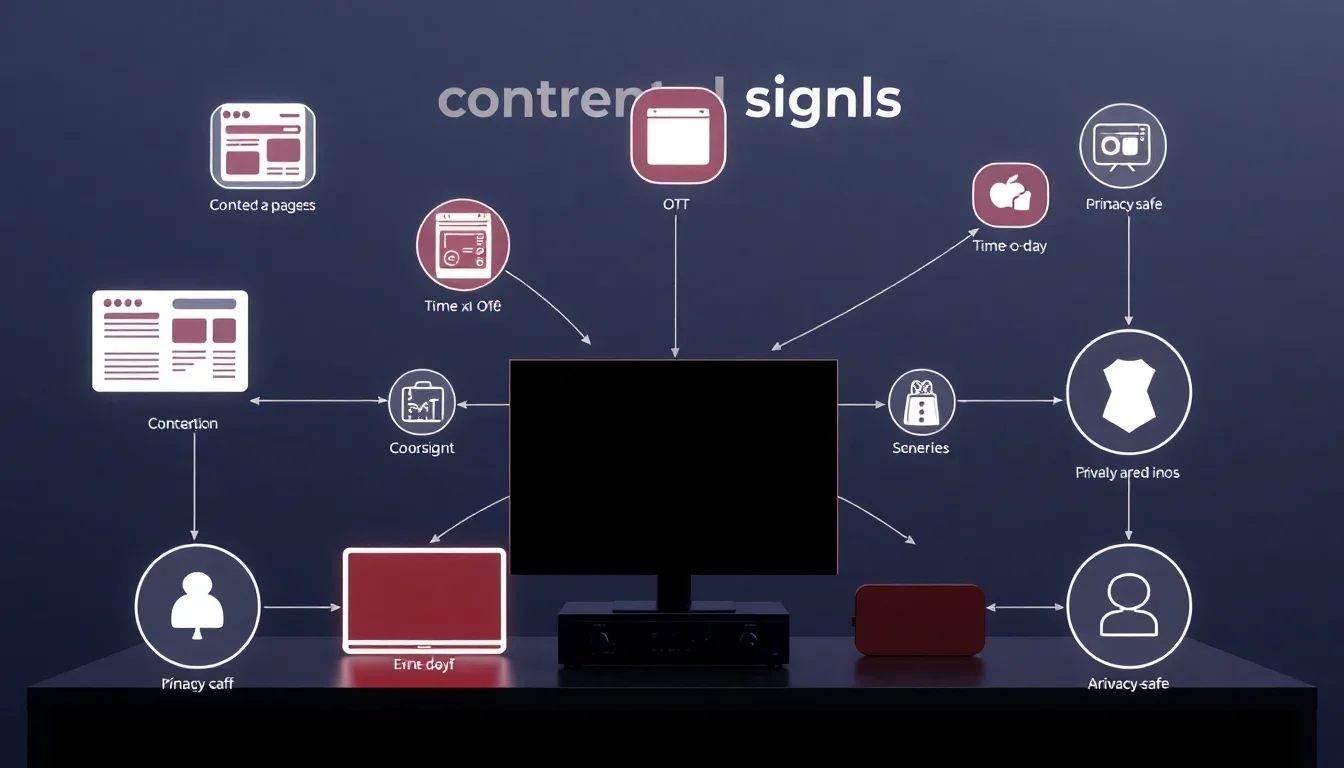
Summary: Contextual signals divide into content-based, on-page, environmental, device/time, and OTT/CTV classes, each with specific attributes and weighting considerations.
Content-based Signals
Examples: topic classification, sentiment, entities (brands, products), intent indicators, and article taxonomy. Use cases: brand-aligned placements, purchase-intent adjacency, and safe-context avoidance. Measurement: track engagement lift and click-through rate (CTR) by topic cluster.
On-page Signals
Examples: meta tags, schema.org markup, header hierarchy, ad density, and presence of affiliate or sponsored labels. Use cases: granular brand-safety rules and inventory scoring. Measurement: correlate on-page signal presence with viewability and brand metrics.
Environmental Signals
Examples: time of day, weather conditions, live events, publisher reputation, and adjacent content types (comments, user-generated sections). Use cases: contextual seasonality campaigns and real-time creative adjustments.
Device and Temporal Signals
Examples: device type (mobile, desktop, connected TV), connection speed, orientation, and temporal windows (hour, weekday). Use cases: creative selection, frequency capping, and bid shading.
OTT/CTV Signals
Examples: program genre, show metadata, stream audio transcript topics, ad pod position, and time-shifted vs live status. Use cases: brand suitability for broadcast-like environments and creative sequencing. Note: OTT metadata granularity varies by publisher; validate before scaling.
Key takeaway: Combining multiple signal classes increases targeting fidelity while reducing reliance on user-level identifiers.
Section 4: Measurement Frameworks — How to Measure Contextual ROI
Direct answer: Measure contextual ROI using a combination of incremental tests, media-mix models, standardized KPIs, and privacy-safe attribution windows to isolate ad-driven outcomes.
Measurement challenges: absence of user-level identifiers requires aggregate and experimental approaches. Use randomized exposure, geo holdouts, and time-based A/B tests where feasible. Combine these with modeling techniques such as uplift modeling and media-mix modeling to allocate credit across channels.
Core KPIs and Benchmarks
- Engagement: view-through rate, video completion rate (VCR), and time-on-page.
- Efficiency: effective CPM (eCPM), cost per completed view (CPCV), and cost per thousand viewable impressions (vCPM).
- Outcomes: post-view conversions, assisted conversions, brand lift metrics (awareness, favorability), and incremental conversions from holdout tests.
Simple ROI Formula Example
Direct ROI formula: (Incremental Revenue − Media Cost) / Media Cost. Example: If incremental revenue from a geo holdout is $120,000 and media cost is $30,000, ROI = (120,000 − 30,000) / 30,000 = 3.0 or 300%. See also E E A T.
Attribution and Windows
Recommendation: Use multiple windows (1-day, 7-day, 28-day) depending on sales cycle, and present results with confidence intervals. For long-sales-cycle categories, rely more on media-mix and uplift modeling than short-window last-click attribution. See also Canonical Tags.
Practical Measurement Approaches
- Randomized Controlled Trials (RCTs): Randomly assign inventory or geographies to measure lift. Best for causal inference.
- Geo Holdouts: Hold out specific regions to estimate incremental outcomes when RCTs at user level are impractical.
- Media-Mix Modeling (MMM): Use aggregated data over time to infer channel contributions adjusted for seasonality and external factors.
- Hybrid Modeling: Combine experiment-derived lift curves with MMM for stabilized estimates.
Key takeaway: Use experiment-first approaches where feasible, complemented by modeling to scale insights and translate signal performance into ROI.
Section 5: Platform Implementation & Settings — Where to Activate Contextual Signals
Summary: Activate contextual signals in Google Ads, major DSPs, and publisher tools; configure taxonomy, scoring, creative associations, and reporting to align with campaign goals.
Google Ads and DV360
How to: Use category and content keyword targeting, and apply content label exclusions for brand safety. Configure custom intent and topic segments where available. For programmatic line items, use contextual segments and custom taxonomy mappings in DV360. Best practice: Combine contextual bids with value-based bidding strategies and set clear inventory quality filters.
Demand-Side Platforms (DSPs)
How to: Import or define contextual segments, set signal weights, and connect content classifiers. Use DSP APIs to ingest publisher metadata and custom signals. Best practice: Test multiple signal weight configurations and enable reporting on signal-level performance.
Supply-Side Platforms (SSPs) and Publisher Tools
How to: Ensure publisher metadata and content classification are accurate. Implement schema.org markup and ensure video metadata includes program and scene-level descriptors for OTT. Best practice: Audit publisher tagging and require transparency on classification methods.
Social and Native Platforms
How to: Use on-platform contextual selectors (topics, placements, interests based on content), but validate performance as social platforms often blend content signals with soft user signals. Best practice: Treat social contextual targeting as complementary rather than primary for direct-response campaigns unless validated.
Implementation Checklist
- Define taxonomy aligned to campaign goals.
- Map creative variants to signal clusters.
- Set signal weighting and threshold rules in DSP or campaign platform.
- Activate brand-safety and inventory-quality filters.
- Establish measurement plan with holdouts or experiments.
Key takeaway: Platform settings require taxonomy alignment, signal weighting, creative mapping, and measurement configuration to realize contextual signal value.
Section 6: Privacy, Compliance & Brand Safety
Direct answer: Contextual signals reduce reliance on personal data but require compliance with GDPR, CCPA-equivalents, and publisher consent policies while maintaining rigorous brand-safety controls.
Regulatory considerations: Contextual targeting operates on non-personal signals and is generally compatible with data-minimization principles. Still, jurisdictional rules on metadata, geolocation granularity, and device identifiers require evaluation. Implement data governance, retention limits, and vendor assessments.
Brand Safety Controls
- Category exclusions and negative keyword lists.
- Publisher scoring and whitelists/blacklists.
- Automated content classification alongside human review for edge cases.
- Third-party verification for viewability and brand safety signals.
Consent and Transparency
Publishers must surface consent where required. Advertisers should document signal sources and maintain transparency in measurement approaches. Contracts with partners should specify allowable signal usage and audit rights.
Key takeaway: Contextual approaches simplify privacy alignment but require disciplined governance and layered safety controls to maintain brand integrity.
Section 7: Benefits, Limitations & Trade-offs
Direct answer: Contextual signals offer privacy-preserving relevance and improved brand safety but trade off some longitudinal behavioral insights and cross-device persistence. Learn more at Contextual advertising.
Benefits:
- Privacy-aligned: operates without user-level identifiers.
- Brand safety: contextual filters avoid undesirable content adjacency.
- Creative relevance: enables context-specific creatives and messaging.
- Cross-device attractiveness: content-level correlation works across devices with proper inventory mapping.
Limitations and trade-offs:
- Limited personal lifetime view: lacks user history for long-term personalization.
- Signal variability: content quality and metadata accuracy vary between publishers.
- Attribution complexity: measuring downstream conversions requires aggregated or experimental methods.
- Scale constraints in niche OTT content where metadata is sparse.
Key takeaway: Use contextual signals where privacy and brand safety are priorities; offset limitations with targeted experiments and cross-channel orchestration. Read more at What is Contextual Advertising? Why is it Important?.
Section 8: Case Studies — Real-World Examples
Case Study 1 — Retail Seasonal Campaign
Background: National retail brand needed a privacy-safe holiday push for mid-funnel promotions across display and OTT. Challenge: reduce reliance on third-party segments while maintaining sales lift. For details, see Contextual Signals Win as Data Accelerates Marketing.
Solution: Implemented topic clusters for holiday-related content, enriched with time-of-day and local weather signals to prioritize in-market contexts. Mapped three creative variants to high-relevance clusters and used geo holdouts for measurement. Additional insights at Contextual Signals: The Future of OTT Discovery.
Results: Incremental revenue lift of 2.8x vs baseline in holdout regions; eCPM increased by 15% while CPA decreased by 22%. Video completion rate improved by 18% in matched contexts. [Source: Internal campaign benchmarks, 2024]
Takeaway: Contextual clustering plus temporal signals drove relevant delivery and improved efficiency without personal data usage.
Case Study 2 — B2B Thought-Leadership Promotion
Background: B2B software vendor needed to promote research content to executives without using cookie-based targeting. Challenge: reach decision-makers reliably in a privacy-first environment.
Solution: Used article-level entity extraction and professional content taxonomy to identify publisher verticals and whitepaper-adjacent contexts. Combined contextual segments with contextual overlays on CTV programming aligned to business news and technology shows.
Results: Lead quality improved with qualified leads per spend up 35%; brand recall in survey-based brand-lift tests increased by 12%. Cost per qualified lead decreased by 28% relative to prior behavioral campaigns. [Source: Internal campaign report, 2024]
Takeaway: High-quality content taxonomy and cross-channel contextual mapping can substitute behavioral segments for B2B outcomes.
Key takeaway: Case evidence shows contextual signals produce measurable business outcomes when combined with disciplined measurement and creative testing.
Section 9: Comparative Landscape — Contextual Signals vs Behavioral Targeting
Direct answer: Contextual signals target by environment and content; behavioral targeting targets by past user actions. Each approach has distinct trade-offs for privacy, relevance persistence, and attribution.
| Signal Type | Contextual Signals | Behavioral Targeting | Key Trade-offs |
|---|---|---|---|
| Basis | Content, environment, device/time | Past user actions, cookies, device IDs | Privacy vs personalization |
| Privacy | High (non-personal) | Lower (user identifiers) | Regulatory risk for behavioral |
| Persistence | Session/context-specific | Longitudinal across sessions | Behavioral retains history |
| Scale | High across premium inventory; limited in niche OTT | Wide where identifiers exist | Contextual needs taxonomy work |
| Measurement | Aggregate/experimental approaches | User-level attribution when permitted | Attribution complexity differs |
| Use Cases | Brand safety, relevance, privacy-first campaigns | Retargeting, personalization, lifecycle marketing | Choose per objective |
Key takeaway: Use contextual signals to achieve privacy-preserving relevance and brand safety; use behavioral targeting where longitudinal personalization and retargeting are essential and compliant.
Section 10: Future Trends & 2026 Outlook
Direct answer: Expect AI-assisted signal interpretation, privacy-preserving modeling, and cross-channel orchestration to drive contextual targeting advances through 2026.
Emerging trends:
- Advanced embeddings and multimodal models will improve content understanding at page and scene levels.
- Privacy-preserving techniques (federated learning, differential privacy) will allow model refinement without user-level data exchange.
- Scene-level and audio transcript analysis for OTT will enable finer-grained contextual match for connected TV inventory.
- Real-time creative adaptation tied to contextual scores will scale with programmatic DCO workflows.
- Standardized contextual taxonomies and measurement frameworks from industry groups will reduce fragmentation.
Key takeaway: Investment in AI-driven context extraction and privacy-first model techniques will determine competitive advantage in contextual targeting.
Section 11: Getting Started — 14-Day Pilot and 30/60/90 Roadmap
Direct answer: Start with a focused 14-day pilot to validate signal taxonomy, creative mapping, and measurement; expand via a 30/60/90 roadmap based on pilot outcomes.
14-Day Pilot Plan (Concise)
- Day 1–2: Signal audit — inventory sample, metadata quality check, and taxonomy mapping.
- Day 3–5: Segment design — create 3–5 contextual segments with clear hypotheses.
- Day 6–9: Creative mapping — prepare 2–3 creative variants per segment and QA dynamic assets.
- Day 10–12: Launch with geo holdouts or randomized exposure and enable signal-level reporting.
- Day 13–14: Analyze results, compute incremental lift, and document lessons learned.
30/60/90-Day Roadmap
- 30 days: Scale winning segments, refine scoring, and expand inventory sources.
- 60 days: Integrate cross-channel contextual mapping for OTT and native display; begin MMM baselining.
- 90 days: Establish continuous optimization loops, deploy creative personalization at scale, and formalize governance and vendor SLAs.
Key takeaway: Use a short, hypothesis-driven pilot with clear measurement to de-risk scale decisions and iterate rapidly.
Section 12: Regional & Industry Nuances
Direct answer: Regional regulations and industry-specific content norms shape contextual signal usage; adjust granularity, consent flows, and taxonomy per jurisdiction and vertical.
Regulatory highlights:
- EU (GDPR): Avoid personal data processing for contextual signal extraction; ensure publishers provide lawful basis for metadata where required.
- US (State-level privacy laws): Map geolocation granularity and vendor obligations per state; prefer aggregated signals for higher-risk states.
- APAC: Local rules vary—document consent and data-handling requirements for each market before scaling.
Industry-specific considerations:
- Healthcare and pharmaceuticals: Apply strict brand-safety rules and avoid medical advice adjacency; consult legal counsel for regulated claims.
- Finance: Avoid risky adjacency to fraud or legal content; validate publisher reputation and use human review for borderline content.
- Entertainment and retail: Leverage contextual seasonality and show-level metadata for OTT and video campaigns.
Key takeaway: Localize taxonomy, consent mechanisms, and safety controls to match regional regulation and vertical risk tolerances.
Request: Personalized signal-audit available for teams ready to validate taxonomy and measurement readiness.
FAQ
What are contextual signals?
Contextual signals are situational, content-derived cues that inform ad relevance based on the environment and content rather than on individual user identifiers. These signals include semantic topics, sentiment, on-page metadata, device and time variables, and OTT program metadata, enabling privacy-aligned targeting.
How do contextual signals differ from behavioral targeting?
Contextual signals target based on content and environment; behavioral targeting uses past user actions and identifiers. Contextual targeting preserves privacy and focuses on immediate relevance, while behavioral targeting provides longitudinal personalization and retargeting capabilities where permitted.
What are common examples of contextual signals for OTT/CTV?
OTT/CTV signals include program genre, show and episode metadata, audio transcript topics, ad pod position, live versus time-shifted status, and device model. These signals enable placement in contextually aligned programming and support creative sequencing appropriate for the content.
How do you measure the ROI of contextual targeting?
Measure ROI through randomized experiments, geo holdouts, and media-mix modeling. Core KPIs include incremental revenue, cost per incremental conversion, viewability, video completion rate, and brand-lift survey metrics. Use multiple attribution windows and report confidence intervals.
Can contextual signals replace third-party cookies entirely?
Contextual signals can replace many use cases previously served by third-party cookies, especially for upper- and mid-funnel campaigns and brand-safety needs. Retargeting and long-term personalization still commonly rely on user-level signals unless alternative identity solutions are in place.
What tools and platforms support contextual targeting?
Major DSPs, Google Ads (topic and content targeting), DV360, SSPs, and select social platforms offer contextual targeting capabilities. Implementation requires taxonomy configuration, signal ingestion, and measurement integration specific to each platform’s features.
How should advertisers design creatives for contextual campaigns?
Design creatives tailored to content clusters and situational signals (time, weather, device). Use dynamic creative variants optimized for each contextual segment, and prioritize concise messaging that aligns with surrounding content to improve relevance and engagement.
What are the risks associated with contextual signals?
Primary risks include incorrect content classification, sparse metadata on some inventory, and misaligned creative that reduces effectiveness. Mitigate these risks through publisher audits, human review of edge cases, and continuous measurement with holdouts.
How granular should contextual taxonomies be?
Taxonomy granularity depends on campaign objectives: broader clusters work for brand reach, while fine-grained taxonomies benefit direct-response and vertical-specific campaigns. Validate granularity with pilot tests to balance scale and relevance.
How do privacy laws affect contextual signal use?
Privacy laws favor contextual targeting because it avoids personal data, but regional requirements on metadata, geolocation, and consent still apply. Maintain documented data governance, vendor contracts, and audit trails to demonstrate compliance.
What benchmarks should I expect from contextual campaigns?
Benchmarks vary by vertical and channel. Case evidence shows contextual approaches reducing CPA by 15–30% and improving engagement metrics like VCR by mid-teens in optimized campaigns. Establish baseline benchmarks through pilot holdouts for accurate comparisons.
How to debug noisy results in contextual campaigns?
Debug by auditing signal quality: sample inventory, validate metadata, check content classification accuracy, and review creative-to-context mapping. Run controlled experiments or smaller holdouts to isolate underperforming segments and refine scoring rules.
Conclusion: Contextual signals provide a pragmatic, privacy-aligned path to relevance and brand safety in modern advertising. They combine semantic content analysis, environmental and device cues, and platform-specific activations to deliver measurable outcomes without user-level identifiers. Implement a short, hypothesis-driven pilot to validate taxonomy, creative mapping, and measurement. If pilot results show positive incremental lift, scale using a 30/60/90 roadmap while maintaining governance, brand-safety controls, and experimental measurement. Start with defining clear campaign objectives, selecting high-quality inventory, and applying incremental tests to quantify ROI. The next step is a focused 14-day pilot: run three contextual segments, map creative variants, and use geo holdouts to measure lift. Strong contextual strategies reduce regulatory risk, improve creative relevance, and maintain performance at scale.
Sources & References: Google Ads Help; IAB Tech Lab; Nielsen; Think with Google; Industry campaign benchmarks (2023–2025).