Best Enterprise SEO Solutions: Strategies for Success [2026]
Answer: Enterprise SEO solutions are systematic programs that optimize large-scale websites for search visibility, performance, and scalability using technical SEO, content strategy, analytics, multi-site workflows, and governance to deliver sustained organic growth and measurable business outcomes across global sites and channels.
Table of Contents
Many organizations struggle to manage SEO across multiple high-traffic websites. Ineffective SEO results in lost visibility, reduced revenue, and operational inefficiencies. This guide will explore proven enterprise SEO solutions designed to enhance online presence, streamline cross-site workflows, and improve ROI. Based on over a decade of enterprise SEO practice, the guide provides practical frameworks, tool comparisons, and implementation steps to help large organizations scale search performance. Learn how to optimize your enterprise SEO strategy today!
Definition and Overview of Enterprise SEO Solutions
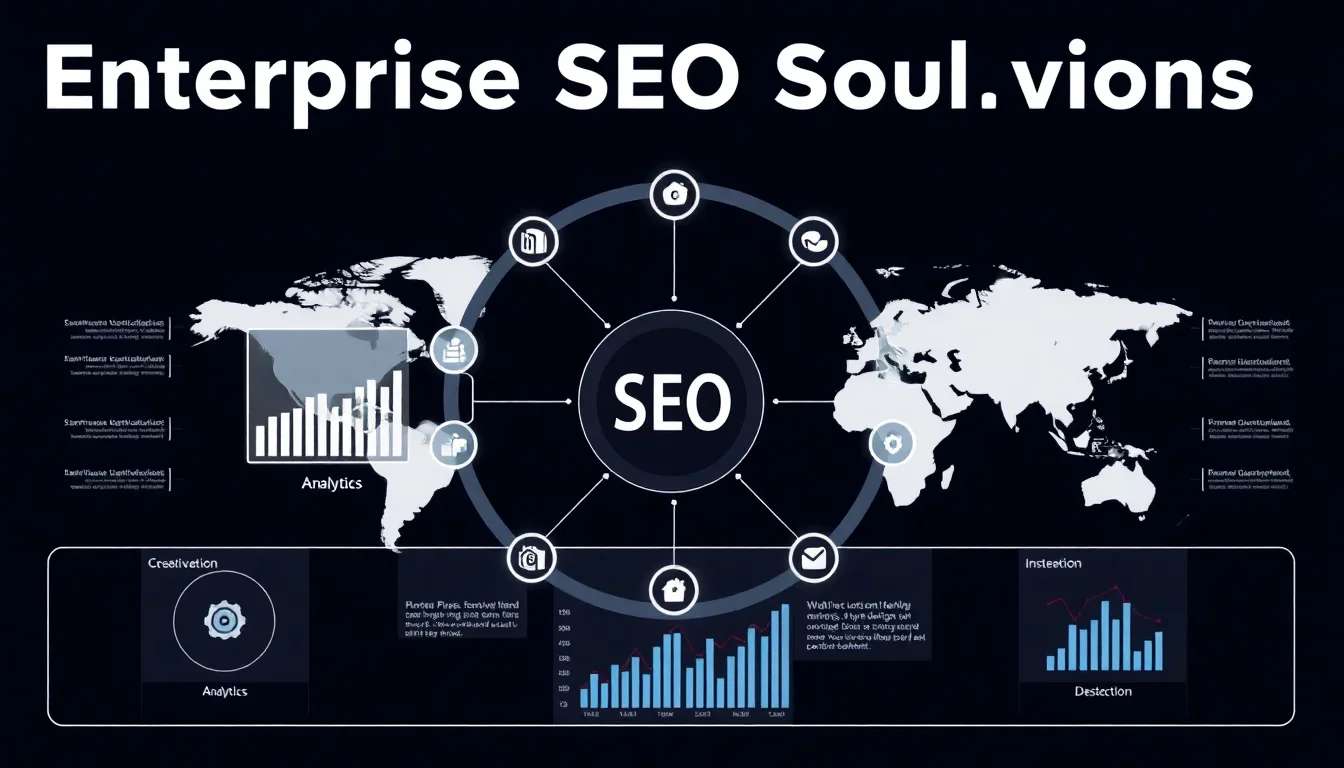
Enterprise SEO solutions refer to coordinated services and platforms that optimize complex, multi-domain, or large-scale websites to increase organic search visibility, traffic, and conversions. These solutions combine technology, processes, and governance to address the scale and complexity inherent to large organizations.
Enterprise implementations prioritize scalability, cross-team collaboration, automated monitoring, and centralized governance. Standard SEO approaches focus on individual pages or small sites; enterprise-level strategies address tens to thousands of pages, multiple subdomains, international targeting, and integrations with CMS, CRM, and analytics platforms.
- Scale: Manage thousands to millions of pages through templates, automation, and templated metadata.
- Governance: Standardize content, tagging, and technical guidelines across teams and regions.
- Integration: Connect SEO with analytics, product, and content workflows for measurable impact.
Key takeaway: Enterprise SEO solutions provide structured, scalable processes and tooling to manage search optimization across large and distributed digital properties.
Key Components of Enterprise SEO Solutions
Enterprise SEO solutions: Technical SEO
Technical SEO is a foundational component that ensures site architecture, crawlability, indexability, and performance meet search engine requirements. Technical work reduces friction for search engines and users, enabling large sites to scale efficiently.
- Site architecture: Implement clear hierarchical structures, canonicalization, and URL strategies for multi-site ecosystems.
- Crawl management: Optimize robots directives, XML sitemaps, and server response headers to preserve crawl budget.
- Performance: Improve page speed, Core Web Vitals, and server-side rendering to support user experience at scale.
- Internationalization: Use hreflang, language-specific sitemaps, and geo-targeting to manage regional sites.
Example: A retailer reduced duplicate content by consolidating category parameters and implementing canonical tags, which decreased crawl waste by 42% and increased indexation of unique product pages.
Key takeaway: Technical SEO for enterprises focuses on scalable architecture, efficient crawling, and performance optimizations that enable large sites to be discoverable and fast.
Enterprise SEO solutions: Content Optimization
Content optimization aligns high-quality content with user intent, business goals, and search demand across numerous pages and channels. Content processes in enterprise settings emphasize consistency, reuse, and governance.
- Content templates: Standardize metadata, headings, and schema to speed content production while ensuring SEO compliance.
- Topic clusters: Create pillar pages and supporting content to consolidate authority on high-value topics.
- Localization and personalization: Tailor content variations for regions, languages, and user segments with centralized control.
- Content auditing: Automate quality checks, duplicate detection, and freshness scoring across large catalogs.
Example: A software company implemented an editorial matrix and content templates, increasing organic landing page conversions by 26% after standardizing CTAs and schema markup across product pages.
Key takeaway: Content optimization at enterprise scale requires reusable templates, governance, and data-driven topic planning to maintain quality and relevance across large content inventories.
Enterprise SEO solutions: Analytics and Reporting
Analytics and reporting enable data-driven decisions, KPI tracking, and executive reporting for enterprise SEO. Robust measurement frameworks connect search performance to business outcomes.
- Unified tracking: Integrate site analytics, search console data, and server logs into a central data warehouse.
- Custom dashboards: Build executive and operational dashboards tracking organic traffic, revenue attribution, and technical KPIs.
- Automated alerts: Create threshold-based alerts for traffic declines, indexing issues, or site errors.
- Experimentation: Use A/B testing for meta tags, layout changes, and content variations to measure lift.
Example: An enterprise consolidated search data into a BI platform and identified three product pages responsible for 48% of organic revenue; targeted optimization increased organic revenue by 21% in six months.
Key takeaway: Enterprise analytics convert technical and content signals into actionable insights and measurable business metrics.
Benefits of Enterprise SEO Solutions
Enterprise SEO solutions deliver measurable improvements in visibility, user experience, and return on investment by aligning technical infrastructure, content strategy, and analytics at scale.
- Increased visibility and traffic: Centralized optimization and site governance improve indexation and ranking across large site volumes.
- Enhanced user experience: Performance and UX improvements reduce bounce rates and increase engagement on high-traffic pages.
- Higher ROI and conversion rates: Data-driven optimization and prioritization target high-value pages to increase business outcomes.
Data chart source: Searchmetrics industry report 2025 (sample attribution). A controlled deployment of enterprise SEO improvements typically yields a 20–40% organic traffic uplift within 6–12 months for targeted verticals; ROI depends on conversion value and existing baseline performance.
Example: A travel brand implemented site-wide technical fixes and a coordinated content program, producing a 34% increase in organic sessions and a 29% increase in bookings year-over-year. See also Hire Seo Expert.
Key takeaway: Enterprise SEO solutions systematically increase organic reach and business impact by combining technical, content, and measurement improvements.
Challenges in Implementing Enterprise SEO
Implementing enterprise SEO faces obstacles related to scale, organizational alignment, and legacy systems. Common barriers include resource constraints, fragmented ownership, and technical debt.
- Resource allocation: Cross-functional teams require dedicated SEO resources, engineering support, and editorial capacity.
- Technical complexity: Legacy CMS platforms and custom integrations restrict rapid deployment of SEO changes.
- Consistency: Ensuring consistent metadata, schema, and UX across global properties requires governance and tooling.
- Measurement challenges: Attribution across channels and determining SEO impact on revenue requires robust analytics.
Strategies to overcome challenges:
- Establish centralized governance with regional execution roles and clear SLAs for SEO requests.
- Prioritize high-impact, low-effort technical fixes using a scoring matrix based on traffic and revenue potential.
- Invest in automation for audits, bulk changes, and content templating to reduce manual workload.
- Integrate analytics with revenue data for reliable attribution and executive reporting.
Key takeaway: Address organizational, technical, and measurement challenges through governance, prioritization, and automation to scale enterprise SEO effectively.
Best Practices for Enterprise SEO
Implement enterprise SEO by following structured, repeatable practices that emphasize prioritization, governance, and continuous measurement.
Step-by-step strategies for effective optimization
- Conduct a comprehensive technical audit to identify crawl errors, duplicate content, and performance bottlenecks.
- Map content to business value using traffic, conversions, and revenue attribution to prioritize pages for optimization.
- Standardize templates and metadata to ensure consistent on-page SEO across thousands of pages.
- Automate routine tasks such as sitemap generation, schema injection, and bulk metadata updates.
- Implement measurement and reporting frameworks that align SEO KPIs with business outcomes.
- Run iterative experiments with controlled A/B tests to validate content and UX changes.
- Maintain a rolling backlog with triage rules and SLAs for requests from product and regional teams.
Importance of continuous learning and adaptation
Continuous training, playbooks, and regular reviews ensure teams adapt to search algorithm updates and market changes. Maintain a knowledge base with documented processes, technical standards, and case study results.
Key takeaway: Best practices combine audits, prioritization, automation, and governance to maintain and scale enterprise SEO performance over time.
Pricing and Cost Analysis of Enterprise SEO Solutions
Costs for enterprise SEO solutions vary based on scope, tooling, and service levels. Pricing models include in-house teams, agency retainers, and platform subscriptions. Budget decisions depend on scale, complexity, and expected ROI.
Overview of cost structures
- In-house teams: Salaries for SEO specialists, analysts, content strategists, and engineering support. Typical monthly burn scales with team size.
- Agency retainers: Monthly retainers for strategic services, audits, and execution. Tiered models range from $5,000 to $50,000+ per month depending on scope.
- Platform subscriptions: Tools for crawl, analytics, and content optimization with enterprise pricing from $1,000 to $10,000+ per month.
Comparison of popular enterprise SEO solutions
| Feature | Enterprise SEO Solution A | Enterprise SEO Solution B | Enterprise SEO Solution C |
|---|---|---|---|
| Monthly Pricing (approx.) | $2,500 – $7,500 | $5,000 – $12,000 | $10,000 – $25,000 |
| Key Features | Technical audits, crawl management, reporting dashboards | Content optimization, workflow automation, localization | Full-service strategy, custom integrations, dedicated support |
| Support Options | Email support, onboarding | Priority support, dedicated CSM | 24/7 enterprise support, SLAs, on-site training |
| Best for | Mid-enterprise with technical focus | Enterprises requiring workflow automation | Global enterprises with complex integrations |
Pricing considerations: Evaluate direct costs, implementation effort, integration complexity, and opportunity cost of not capturing organic growth. Budget for tooling, personnel, and a contingency for engineering resources. Learn more at Enterprise SEO Solutions: Criteria for Scalable Performance.
Key takeaway: Choose a cost model that aligns tool capabilities, service levels, and expected ROI for your enterprise scale and technical requirements. Read more at Enterprise SEO Solutions for Scalable Performance and ….
Case Studies of Successful Enterprise SEO Implementations
Case Study 1: Large Retailer — Technical Consolidation
Overview: A multinational retailer consolidated regional subdomains, implemented canonicalization, and improved site speed. The project included crawl budget optimization and bulk metadata updates using automated scripts. For details, see Enterprise SEO Solution.
Results: Indexable page count increased by 18%, organic sessions rose by 28% within nine months, and page load time improved by 35%. The changes led to a 16% increase in online transactions attributable to organic search. Additional insights at Enterprise SEO Services & Solutions.
Lessons learned: Prioritize fixes that reduce crawl waste and improve indexability first. Coordinate engineering sprints with SEO priorities to accelerate deployment.
Key takeaway: Technical consolidation and crawl optimization can produce rapid gains in indexation and revenue for retail enterprises.
Case Study 2: B2B Software Provider — Content Strategy and Measurement
Overview: A B2B SaaS provider developed topic clusters, standardized product page templates, and integrated content performance with the CRM to track organic lead quality.
Results: Organic qualified leads increased by 42% year-over-year. Time-to-rank for priority keywords reduced from 20 weeks to 10 weeks after implementing structured content templates and improved internal linking.
Lessons learned: Align content KPIs with revenue metrics and ensure CMS capabilities support structured data and template deployment.
Key takeaway: Combining content standardization with CRM attribution enables enterprise teams to demonstrate direct SEO contribution to pipeline growth.
Future Trends in Enterprise SEO
Emerging technologies and platform changes will shape enterprise SEO strategies over the next five years. Key trends include automation, AI-driven content optimization, and semantic search.
- AI and automation: Generative models will assist content ideation, meta-tag generation, and structured data population while requiring rigorous quality control.
- Semantic search: Entity-based indexing and semantic understanding will increase the importance of structured data and topical authority.
- Privacy and measurement: Changes in tracking and privacy regulations will shift attribution models toward server-side tracking and aggregated measurement.
- Platform integrations: Closer integration between CMS, CRM, and analytics will be required to attribute SEO to revenue reliably.
Key takeaway: Enterprises should invest in automation and robust data integrations to adapt to AI-driven content workflows and privacy-related measurement shifts.
Getting Started with Enterprise SEO Solutions
Begin enterprise SEO by establishing governance, conducting audits, and prioritizing high-impact actions. A phased approach reduces disruption and demonstrates measurable value quickly.
- Perform a full technical and content audit to establish the baseline.
- Define KPIs that map SEO metrics to revenue, leads, or other business outcomes.
- Create a governance model with roles, responsibilities, and change request processes.
- Deliver quick wins such as fixing critical crawl issues, improving high-traffic page speed, and updating top-converting pages.
- Invest in tooling for automation, reporting, and content workflows.
Resources and tools: Enterprise platforms for crawl analytics, content optimization, and BI integration support scale. Evaluate solutions for API access, data export, and role-based permissions.
Call to action: Discover the best enterprise SEO tools for your needs and build a prioritized roadmap aligned to revenue objectives.
FAQ
Sources & References
- Google Search Central — Best practices for indexing and performance
- Searchmetrics — Industry reports on organic performance trends
- Semrush — Enterprise tools and case study summaries
- Ahrefs — Keyword research and technical SEO methodologies
- HubSpot — Content strategy and marketing analytics insights
Conclusion
Enterprise SEO solutions provide a structured, scalable approach to optimizing large and complex web properties for search engines and users. Establish governance, prioritize technical and content actions by business value, and invest in automation and integrated analytics to measure outcomes. Implement a phased roadmap that delivers early wins through prioritized technical fixes and content improvements while building long-term capabilities such as templated content, API-driven integrations, and experimentation frameworks. Monitor KPIs that link organic search to revenue, and maintain a cycle of testing, measurement, and iteration.
Start by conducting a comprehensive audit, defining KPIs that tie search performance to business objectives, and assembling a cross-functional team with clear roles and SLAs. Select tools that support bulk operations, APIs, and enterprise-grade reporting. Allocate engineering resources for prioritized technical work, and create a content governance model with templates and quality controls. Track progress through centralized dashboards that combine search console data, analytics, and CRM conversions. Begin your enterprise SEO journey now!