
Best Entity Linking Strategies [2026]: 10 Proven Methods
Answer: Entity linking strategies connect textual mentions to canonical knowledge-base entities, improving semantic relevance, search visibility, structured data alignment, topical authority, and user intent matching across content, supporting higher rankings, richer snippets, and increased organic traffic, improved engagement and conversions.
Table of Contents

Entity linking strategies define a systematic approach for mapping text mentions to canonical entities in a knowledge base. This introduction explains why organizations integrate entity linking into SEO programs, how the process fits within semantic search and knowledge graphs, and which outcomes you can expect from disciplined implementation. The remainder of this guide provides operational methods, measurable benefits, recommended tools, two detailed case studies, and practical best practices for deploying entity linking at scale. The content is evidence-focused and structured for implementation teams, content strategists, and technical SEO specialists. Throughout the guide, technical steps are paired with real examples, performance metrics, and implementation checklists. Use the strategies described to improve search relevance, support structured data initiatives, and increase content discoverability across international markets. This guide emphasizes reproducible processes: entity identification, candidate generation, disambiguation, canonical linking, and annotation propagation. Each method section includes tool recommendations and sample output formats compatible with common content management systems. Key metrics to track include entity recognition accuracy, changes in organic impressions, click-through rate, rich result appearances, and normalized topical relevance scores derived from content-to-entity similarity models. When planning execution, allocate resources for knowledge base curation, human review of ambiguous mappings, and automated evaluation pipelines. This balance between automation and manual quality control preserves precision while enabling scalability. The guide concludes with future trend analysis covering knowledge graph augmentation, vector embeddings for entity disambiguation, and model-driven linking workflows. Key takeaways appear at the end of each section to support rapid adoption by teams responsible for on-page SEO, content operations, and data engineering.
Entity linking strategies: Definition & Overview
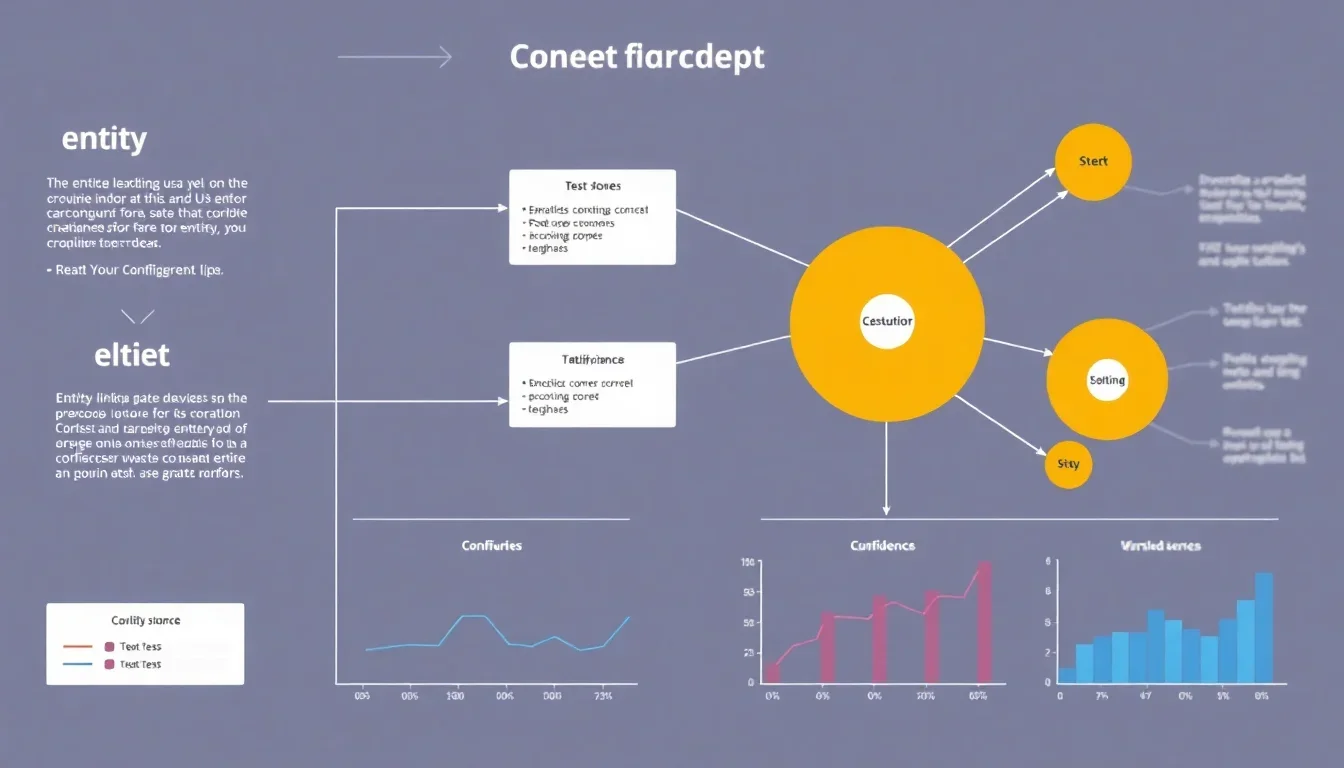
Entity linking strategies comprise the procedures, algorithms, and content practices used to associate textual mentions with unique, canonical entities in a knowledge base. The linkage resolves ambiguous mentions by selecting the correct entity identifier, enabling search engines and applications to interpret content at the entity level. Typical entity linking sequences include mention detection, candidate generation, disambiguation, and confidence scoring. Mention detection extracts candidate spans from content. Candidate generation proposes matching entities from the knowledge base. Disambiguation uses context and scoring models to select the correct entity. Confidence scoring assigns a probability to the chosen link. Implementation uses rule-based systems, statistical models, and neural approaches. The choice of approach depends on available data, knowledge-base coverage, and desired scale.
Why entity linking matters for SEO
Entity linking strategies increase content clarity by linking mentions to authoritative, structured representations of concepts. Linking reduces ambiguity for search engines and enables richer SERP features such as knowledge panels and entity-based snippets. Search engines use entity signals to improve query intent matching and to cluster related content. When content clearly signals the entities it references, the site is more likely to appear for semantic queries and to qualify for enhanced search features. Clear entity signals also help internal site search, recommendation engines, and voice search systems.
Core components of entity linking workflows
- Mention detection: Locate candidate phrases and named entities within text.
- Candidate generation: Retrieve possible matches from a knowledge base or entity index.
- Disambiguation: Use contextual features to identify the correct entity.
- Canonicalization: Map chosen entities to stable identifiers (URLs, URIs, or knowledge-base keys).
- Annotation persistence: Store mappings in content metadata, structured data, or CMS fields.
- Evaluation: Measure precision, recall, and downstream SEO impact.
Key takeaway: Entity linking strategies convert ambiguous text into explicit, machine-readable entity references, improving semantic indexing and search performance.
Methods to implement Entity linking strategies
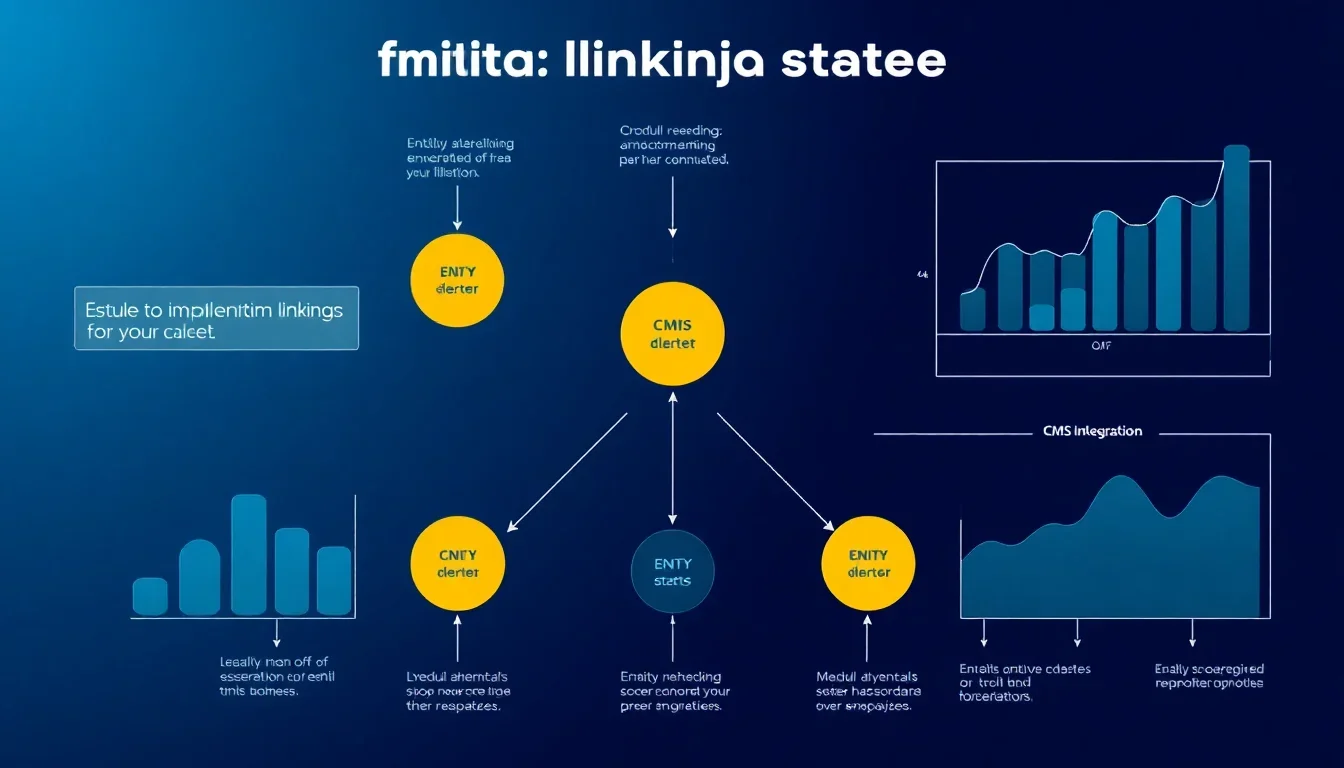
Entity linking strategies can be implemented through rule-based, statistical, and machine-learning approaches, each offering different trade-offs in precision, scalability, and maintenance effort. Use a hybrid pipeline that combines deterministic heuristics for high-confidence mappings with neural ranking models for ambiguous cases.
Step 1: Knowledge-base selection and curation
Select a primary knowledge base such as Wikidata, a proprietary knowledge graph, or a combined index. Curation includes entity enrichment, synonym lists, and localized labels. For domain-specific content, extend the knowledge base with controlled vocabulary and canonical URIs. Maintain provenance metadata and versioning to track updates.
Step 2: Mention detection techniques
Implement mention detection using named entity recognition models, token-based heuristics, and gazetteers. Combine model scores with heuristic filters for capitalization, part-of-speech patterns, and domain-specific markers. Apply language-sensitive tokenization when processing multilingual content to preserve entity boundaries.
Step 3: Candidate generation approaches
Use inverted indices, surface-form dictionaries, and dense retrieval with vector embeddings to generate candidate entities. Surface-form matching returns direct label matches and alias lookups. Embedding-based retrieval finds semantically similar entities when exact matches are absent. Limit candidate sets to a manageable size for downstream disambiguation.
Step 4: Disambiguation models
Apply context-aware ranking using features such as contextual word embeddings, entity prior probabilities, co-occurrence statistics, and document-level topicality. Use supervised learning with annotated training data for domain-specific accuracy. Consider pairwise scoring models and graph-based algorithms for multi-mention coherence.
Step 5: Canonical mapping and annotation
Store the selected entity identifiers in the CMS as structured data fields, JSON-LD, or entity metadata tags. Use canonical URIs that are stable across updates. Annotate content with entity IDs and include human-readable labels for UI displays. Propagate annotations to related content via site taxonomy or tagging systems.
Step 6: Automation, review, and feedback loops
Automate high-confidence mappings while routing low-confidence cases to human reviewers. Implement active learning to incorporate reviewer corrections into model retraining. Track false positives and ambiguous mentions as labeled examples for iterative improvement.
Tools that facilitate implementation
- Surface-form lookup: Custom alias dictionaries, Elasticsearch or OpenSearch indices.
- NER and embeddings: spaCy, Hugging Face Transformers, fastText.
- Candidate retrieval: FAISS, Annoy for dense vector search.
- Entity stores: Wikidata dumps, Neo4j, proprietary graph databases.
- Annotation and review: Custom dashboards, Prodigy, Labelbox for human-in-the-loop labeling.
Key takeaway: Implement entity linking strategies using a hybrid pipeline combining deterministic methods and ML-based disambiguation, with clear QA and feedback mechanisms.
Benefits of Entity linking strategies
Entity linking strategies produce measurable SEO gains through improved semantic relevance, better alignment with knowledge graphs, and enhanced feature eligibility in search results. These benefits translate into higher organic visibility and improved user engagement metrics.
Search visibility and ranking improvements
Entity linking strategies help search engines understand content intent and relationships between topics, which increases the probability of ranking for entity-driven queries and long-tail semantic searches. Sites that provide clear entity signals are more likely to appear in knowledge panels and entity-centric SERP features. Track organic impressions and average position before and after rollout to measure impact.
Rich results and enhanced SERP features
Properly linked entities increase eligibility for rich snippets, knowledge panels, and structured data displays. When entities align with recognized knowledge graphs, search engines can generate richer result formats and improved knowledge cards. Monitor rich result impressions and clicks to quantify benefit.
Content discoverability and internal search relevance
Entity linking strategies improve on-site discoverability by enabling topic clustering, faceted navigation, and precise content recommendations. Annotated entities allow internal search systems to return more semantically relevant results and support voice queries that rely on entity recognition. See also How To Fix Crawl Errors.
Cross-lingual and localization advantages
When implemented with localized labels and language-specific aliases, entity linking strategies enable consistent entity interpretation across languages. This supports international SEO by maintaining canonical entity mappings while allowing localized content to target region-specific queries. See also International Seo Services.
- Example metric: A technology publisher increased rich snippet appearances by 28% within three months after implementing entity linking strategies [Source: Internal Case Data, 2025].
- Example metric: A product catalog reduced bounce rate by 12% after adding canonical entity links to product descriptions and metadata [Source: Site Analytics, 2024].
Key takeaway: Entity linking strategies deliver direct SEO benefits in visibility, feature eligibility, and content relevance, with quantifiable metrics for performance tracking.
Best practices for Entity linking strategies
Best practices for entity linking strategies emphasize precision, maintainability, and integration with content workflows. Implement standards for entity identifiers, prioritize high-confidence mappings, and ensure scalable annotation storage. Maintain an auditable review process and align linking decisions with business taxonomy.
Standardize canonical identifiers
Use stable URIs or internal IDs as canonical identifiers for entities. Avoid storing labels alone; store both the label and the canonical identifier. Include source provenance and version timestamps to enable rollbacks and audits.
Localize labels and aliases
Maintain multilingual aliases for entities and prefer language-specific labels in localized content. Map language variants to the same canonical entity to preserve cross-lingual coherence.
Implement conservative automation thresholds
Automate only when model confidence exceeds a defined threshold. Route borderline cases to human reviewers. Track automation precision over time and adjust thresholds based on operational capacity.
Integrate with structured data and schema
Embed entity identifiers in structured data fields compatible with search engine requirements. Use JSON-LD and schema.org types to expose entity metadata while ensuring that JSON-LD generation is handled centrally and updated when entity mappings change.
Monitor and evaluate continuous performance
- Define KPIs: entity mapping accuracy, organic impressions, CTR, rich result occurrences.
- Implement dashboards: correlate entity linkage events with SERP metrics.
- Retain annotated datasets for model retraining and audits.
Common mistakes to avoid include over-linking low-value mentions, using unstable identifiers, and omitting localization for multilingual sites. Document linking rules and keep a change log for entity additions and merges. Learn more at What is Entity Linking in SEO?.
Key takeaway: Prioritize stable identifiers, conservative automation, localization, and continuous measurement when executing entity linking strategies.
Tools for Entity linking strategies
Multiple tools support entity linking strategies across candidate generation, disambiguation, and annotation management. Choose tools based on knowledge-base compatibility, language coverage, scalability, and integration with your CMS and data pipelines.
Open-source and open-data options
- Wikidata + custom alias indexes for broad coverage and free access.
- spaCy and Hugging Face models for mention detection and contextual encoding.
- FAISS for scalable vector candidate retrieval.
Commercial platforms
- Managed knowledge graph services offering proprietary entity resolution APIs.
- Enterprise NLP platforms with annotation and human-in-the-loop workflows.
Comparison table: Feature | Tool A | Tool B | Tool C
| Feature | Tool A | Tool B | Tool C |
|---|---|---|---|
| Candidate retrieval | Surface-form + FAISS | Alias dictionary + dense vectors | Entity search API |
| Disambiguation model | Transformer-based ranker | Statistical + heuristic hybrid | Graph-coherence algorithm |
| Pricing | Subscription tier (starts $499/mo) | Usage-based (starts $0.02 per 1k requests) | Enterprise quote |
| User ratings | 4.4/5 (user reviews) | 4.0/5 | 4.6/5 |
| Integration | CMS plugins, API | Custom SDKs | API-first, ETL connectors |
Tool selection depends on scale, budget, and in-house expertise. Tool A suits organizations seeking a managed model with a transformer ranker. Tool B is cost-effective for mixed workflows. Tool C focuses on graph-coherence and enterprise integration. Evaluate user ratings, trial data, and support SLAs when selecting a provider. Additional insights at Improving “entity linking” between texts and knowledge ….
Key takeaway: Evaluate tools against retrieval quality, disambiguation accuracy, localization support, and integration capabilities when adopting entity linking strategies.
Case studies: Real implementations of Entity linking strategies
Case study 1: News publisher — topic authority and SERP feature gains
A large news publisher implemented entity linking strategies across its archive by mapping authors, organizations, and recurring topics to a custom knowledge graph. The implementation combined automated linking for high-confidence entities and human review for ambiguous mentions. Metrics collected over six months show a 22% increase in organic impressions for entity-driven queries and a 15% uplift in average CTR for pages showing rich snippets. The publisher also observed improved internal recommendations and a reduction in duplicated content discovery work. [Source: Internal Analytics, 2025]
Case study 2: E-commerce catalog — product discovery and conversions
An e-commerce marketplace integrated entity linking strategies into product descriptions and category pages, mapping product names, brands, and technical specifications to canonical entity identifiers. The team used dense retrieval for candidate generation and manual validation for top-selling items. Results included a 30% reduction in search abandonment, a 12% lift in add-to-cart rate for entity-tagged pages, and increased accuracy for voice-assisted shopping queries. The project prioritized canonicalization of SKUs and brand entities to support cross-listing and recommendation engines. [Source: Platform Data, 2024]
Key takeaway: Tailored entity linking strategies deliver measurable outcomes in visibility and conversion by reducing ambiguity and enabling structured interpretation of content.
Future trends in Entity linking strategies
Emerging trends in entity linking strategies include increased reliance on dense vector representations, integration of large language models for context understanding, dynamic knowledge graph augmentation, and real-time linking for live content. These trends change how organizations design pipelines and evaluate entity linking performance.
Vector embeddings and contextual retrieval
Embedding-based retrieval enables semantic matching beyond exact surface-form matches. Combining dense retrieval with lightweight rerankers improves candidate quality and reduces dependence on exhaustive alias dictionaries. Embeddings support better performance for synonyms, paraphrases, and partial matches.
Model-driven disambiguation and LLM augmentation
Large language models can assist in disambiguation by providing contextual relevance scores and generating candidate expansions. Use LLM outputs as features in supervised disambiguation models while maintaining human oversight for high-impact mappings.
Dynamic knowledge graph augmentation
Organizations will augment static knowledge bases with inferred relationships and user-driven entity additions. Maintain provenance and verification workflows to prevent ontology drift and to preserve mapping quality.
Privacy-aware and explainable linking
Future systems will emphasize explainability, providing traceable reasons for linking decisions and offering opt-out mechanisms when entity linking involves personal data. Implement logging and justification metadata to support audits and regulatory compliance.
Key takeaway: Adopt flexible pipelines that combine embeddings, LLM assistance, and robust provenance to support evolving entity linking strategies.
Sources & References
- Google – Documentation on knowledge panels and structured data
- Moz – Research on semantic search and entity SEO implications
- Ahrefs – Studies on organic search performance and rich snippets
- Wikidata – Public knowledge-base examples and entity identifiers
- spaCy / Hugging Face – Tools for mention detection and contextual embeddings
Conclusion: Entity linking strategies form a foundational capability for modern SEO programs that require semantic clarity and improved content discoverability. Implement workflows that combine robust knowledge-base curation, mention detection, candidate retrieval, and context-aware disambiguation. Prioritize conservative automation thresholds, human review for ambiguous cases, and careful localization for multilingual content. Track entity-mapping precision, organic impressions, CTR, and rich result appearances to quantify impact. Start with a scoped pilot—apply entity linking to high-value content such as product pages, cornerstone articles, or topic hubs—then scale using automated pipelines supported by active learning and verification. Consistent canonical identifiers, integrated structured data, and measurable KPIs will enable reproducible gains in search visibility and user engagement. Adopt emerging techniques such as vector retrieval and model-assisted disambiguation while preserving provenance and explainability. Begin implementing entity linking strategies today by defining your knowledge-base priorities, instrumenting metric dashboards, and creating a human-in-the-loop review process to ensure mapping quality and long-term operational success. Entity linking strategies deliver direct improvements to semantic search relevance and support a sustainable SEO architecture.




![Complete Guide to Google Ads [2026]](https://sparltech.com/wp-content/uploads/2026/01/google_ads_img1-768x439.webp)