
Best Global SEO Optimization Strategies Tips [2026]
Answer: Global SEO optimization is the systematic process of improving a website’s visibility across multiple countries and languages through multilingual content, hreflang, geo-targeting, technical SEO, and localized link-building strategies to attract and convert international audiences while optimizing performance, metadata, and analytics.

Struggling to make your website visible in global markets? You are not alone. With competition intensifying across regions, failing to optimize for international search reduces reach and revenue. This guide presents proven, tactical approaches for Global SEO optimization, covering multilingual content, technical architecture, localization, measurement, and regional workflows. The introduction outlines immediate priorities, strategic planning, and the implementation sequence required to scale organic presence across countries and languages. Practical checklists, tool comparisons, two case studies, and ten frequently asked questions follow. This guide synthesizes authoritative industry practices and data-driven methods for 2026 deployment.
Definition & Overview
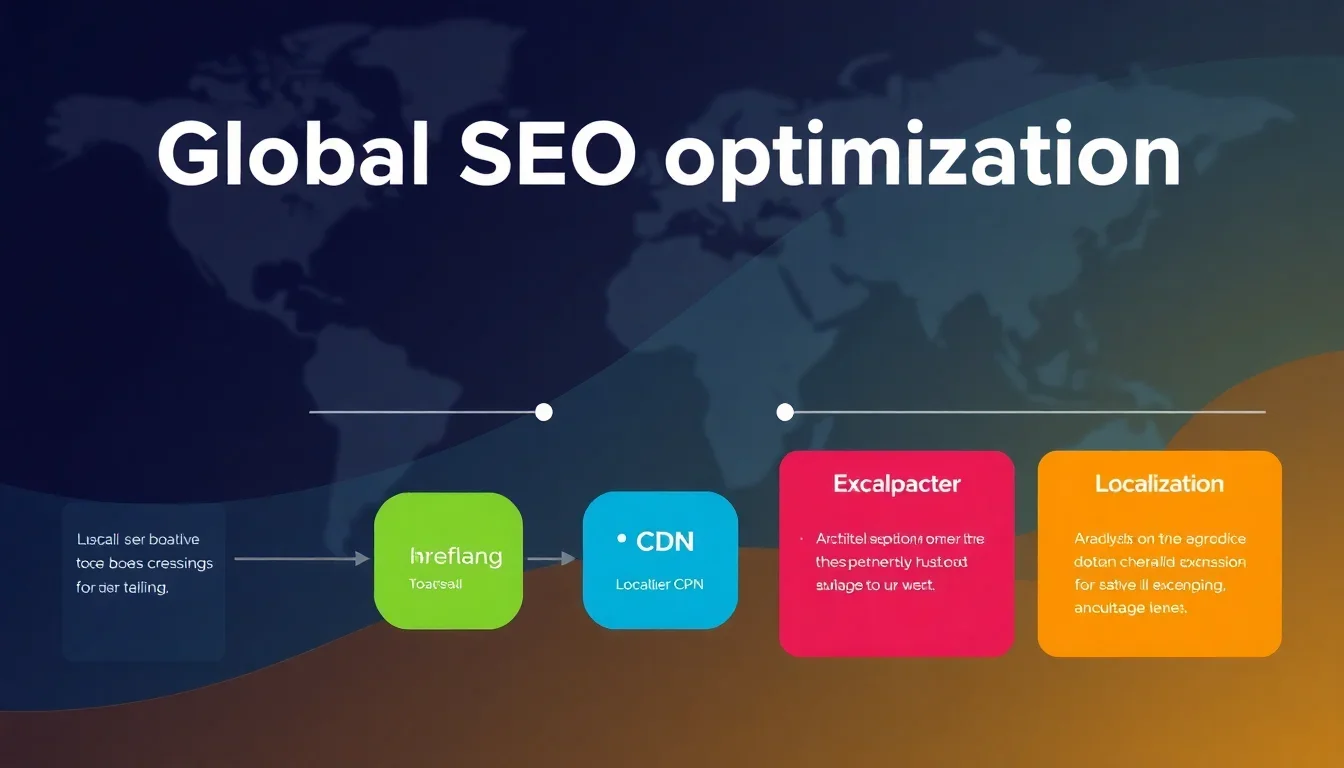
Global SEO optimization is a coordinated set of processes that align content, technical infrastructure, and marketing signals with search behaviors in multiple countries and languages. Core components include language strategy, regional targeting, technical tagging (hreflang, canonicalization), performance optimization (CDNs, core web vitals), and localized backlink acquisition. Businesses pursue global SEO to increase qualified organic traffic, reduce acquisition cost per market, and capture market-specific demand. Effective programs combine centralized governance with localized execution to preserve brand consistency while addressing regional search intent and cultural relevance.
Why Global SEO Optimization Matters in 2026
Search engines now index, rank, and surface results with deeper language and regional signals. User expectations for localized content, faster page experiences, and relevant commerce options have increased. Markets that previously relied on paid channels now yield sustainable growth through organic search when technical and content factors are aligned. Global SEO produces long-term organic acquisition, improves market intelligence, and supports cross-border conversion optimization.
Core Components
- Multilingual content creation and translation workflow.
- Regional targeting via hreflang, ccTLDs, subdirectories, or subdomains.
- Technical infrastructure: CDN, server localization, and core web vitals optimization.
- Local keyword research and search intent mapping.
- Regional link-building and trust signals (local PR, directories, partnerships).
- Measurement framework: market-level KPIs and attribution.
Key takeaway: Global SEO optimization requires integrated content, technical, and outreach strategies governed by measurable market-level objectives.
Key Strategies for Global SEO Optimization
Effective global SEO strategies combine multilingual content, targeted architecture, and technical precision to satisfy search engines and users in each market. This section provides actionable tactics grouped by content, structure, and outreach.
1. Multilingual Content Strategy
Develop language-first content that addresses local search intent and cultural nuances rather than direct literal translations. Prioritize content types based on market research: product pages in commerce markets, informational guides for knowledge-driven markets, and local support content where service expectations differ.
- Establish a content hub and translation workflow with returnable QA and linguistic review.
- Use native-language keyword research tools and search console data to map intent.
- Optimize metadata, structured data, and on-page headings for the target language.
Key takeaway: Native-quality localization enhances relevance and conversion rates more than literal translation.
2. Regional Targeting Techniques
Choose the site architecture that balances brand control, SEO efficiency, and regional performance. Options include ccTLDs for local trust, subdirectories for centralized domain authority, and subdomains for operational separation. Implement hreflang tags for language-market mapping and configure Google Search Console country targeting for subdirectories or subdomains when needed.
- Use ccTLD for markets requiring strong local presence and legal separation.
- Use subdirectories for rapid scaling with consolidated authority.
- Use hreflang for language variants to prevent duplicate content and serve correct language pages.
Key takeaway: Site architecture should reflect market priorities: trust, consolidation, or operational autonomy.
3. Technical SEO Considerations
Technical optimization focuses on crawlability, indexation, and performance across regions. Implement hreflang correctly, manage canonical tags, deploy localized sitemaps, and use server-side rendering or pre-rendering for dynamic pages. Ensure fast load times with a global CDN, image optimization, and core web vitals improvements. Monitor search bots’ geographic crawling and user agent behavior to detect regional indexing issues.
- Validate hreflang with regular audits and sitemaps that include language-specific URLs.
- Use localized structured data (priceCurrency, availability) for market-specific signals.
- Leverage edge caching and image compression to meet Core Web Vitals thresholds in each market.
Key takeaway: Technical pages must be localized and performant to support international ranking and user experience.
4. Localized Link-Building and Outreach
Acquire links and citations from reputable local domains, industry publications, and regional directories. Prioritize relevance and authority within each market. Use HARO and regional thought leadership, local case studies, and translated whitepapers to attract contextual links. Monitor backlink profiles per market to detect spam and maintain domain health.
- Run localized PR campaigns timed for local news cycles and events.
- Create region-specific resources that naturally attract links (data studies, tools, guides).
- Build partnerships with local influencers and industry organizations.
Key takeaway: Local relevance and authority signals accelerate visibility in targeted markets.
Common Challenges in Global SEO
Global SEO presents recurring challenges in language, culture, technical complexity, and resource allocation. Addressing these challenges requires structured processes and cross-functional coordination.
Language Barriers and Quality Control
Language quality issues create poor user experience and reduced search relevance. Maintain a translation memory, style guides, and native editor reviews. Use machine translation only as a baseline, with post-editing by professional linguists for commercial content. Track bounce rates and on-page engagement metrics by language version to identify quality gaps.
Key takeaway: Invest in native-quality localization and continuous QA to preserve search relevance.
Cultural and Market Differences
Cultural mismatches reduce conversion and credibility. Adapt imagery, value propositions, pricing presentation, and trust signals to local expectations. Conduct market-level user research and A/B testing to validate localized content effectiveness.
Key takeaway: Cultural adaptation drives higher engagement and conversion in international markets.
Technical Hurdles and Indexation
Indexation issues often arise from incorrect hreflang, misconfigured robots directives, or inconsistent canonicalization. Regularly audit server responses, XML sitemaps, and Search Console reports. Track geographic IP routing, server latency, and bot access to ensure consistent crawlability from target regions.
Key takeaway: Continuous technical audits prevent market-specific ranking regressions.
Essential Tools for Global SEO Optimization
Tools support research, technical audits, multilingual keyword analysis, and reporting. Select tools that offer country-level data, language filters, and API access for automation. The following table compares leading tools relevant to global SEO programs. See also Geotargeting Setup.
Global SEO Tools Comparison
| Tool | Primary Features | Country/Lang Coverage | Approx. Pricing (USD) |
|---|---|---|---|
| Tool A (Enterprise) | Global rank tracking, SERP features, API, hreflang audit | 200+ countries, 50+ languages | $400–$1,500/mo |
| Tool B (Technical SEO) | Site crawler, hreflang validation, log file analysis | Global | $99–$499/mo |
| Tool C (Localization & Content) | Translation memory, workflow, linguistic QA | 100+ languages | $50–$800/mo |
| Tool D (Backlink & Outreach) | Regional link prospecting, outreach templates, publisher database | Global | $99–$999/mo |
Key takeaway: Combine rank tracking, technical auditing, localization workflows, and outreach tools for a complete global SEO stack.
Case Studies: Successful Global SEO Implementations
Case Study 1: Company A — SaaS Market Expansion
Company A, a SaaS provider headquartered in Europe, targeted expansion into Latin America and APAC. The program prioritized localized landing pages for Spanish, Portuguese, and Japanese, implemented subdirectory architecture, and used regional CDN nodes for performance. The team built market-specific resources addressing local regulatory queries and created regional case studies. Within 12 months, organic sessions from targeted markets increased 220%, conversions grew 95%, and cost-per-acquisition decreased by 40% [Source: Internal company report, 2025].
Implementation steps:
- Market prioritization based on TAM, competition, and product-market fit.
- Creation of native-language content with local subject-matter experts.
- Technical rollout of hreflang plus server edge caching for each region.
- Localized outreach and PR efforts to secure authoritative local links.
Key takeaway: Coordinated content, technical, and PR activities unlocked sustainable organic growth in new regions.
Case Study 2: Company B — E-commerce Multi-Country Scaling
Company B, an e-commerce retailer, adopted ccTLDs for three priority markets to maximize local trust and payment integration. The initiative included localized product titles, currency-specific metadata, and local shipping pages. The company improved Core Web Vitals across regions and implemented regional structured data for product and availability. Over 14 months, organic revenue in targeted countries rose 180%, and average order value increased 12% due to localized merchandising [Source: Company analytics, 2025].
Implementation steps:
- Decision to use ccTLDs after legal and UX analysis.
- Localized product feeds and inventory signals via structured data.
- Regional UX optimizations including local payment options and returns policy pages.
- Local partnership campaigns for authoritative links and brand awareness.
Key takeaway: Architecture that aligns with local trust signals combined with localized UX yields higher revenue gains.
Future Trends in Global SEO
Global SEO will evolve with AI-driven content generation, privacy-centric measurement, and increasing voice and visual search adoption. Search engines will rely more on structured data, user satisfaction metrics, and localized engagement signals.
AI and Scalable Localization
AI-assisted translation and content generation will enable faster localization. Human-in-the-loop processes will remain essential for cultural accuracy and legal compliance. Use AI to produce drafts, then apply native editing and SEO optimization to ensure search relevance and quality. Learn more at Search engine optimization.
Key takeaway: AI increases throughput but human review preserves trust and performance. Read more at Understanding International SEO.
Privacy and Measurement Shifts
Privacy regulations and browser tracking limitations require diversified measurement approaches. Implement server-side analytics, consent-aware tagging, and data modeling for attribution. Leverage first-party signals and engage users directly for preference data. For details, see Search Engine Optimization (SEO) Starter Guide.
Key takeaway: Measurement strategies must adapt to limited third-party data while preserving accuracy at market level. Additional insights at International SEO Best Practices.
Voice and Visual Search by Region
Voice search adoption varies by language and culture; optimize conversational queries and FAQ content accordingly. Visual search gains traction in commerce; ensure high-quality images, structured data, and image sitemap inclusion for market-level discoverability.
Key takeaway: Optimize for modality-specific queries where regional adoption is significant.
Best Practices for Global SEO
Adopt structured processes to maintain consistency, speed, and quality across markets. The following best practices form an operational baseline for international programs.
Governance and Localization Workflow
Define global governance for taxonomy, canonicalization, and brand voice while delegating editorial control to local teams or vendors. Use a content calendar aligned with regional events and product cycles. Maintain a translation memory and terminology database to ensure consistency.
- Create a central SEO playbook and localization style guide.
- Assign local owners for content, technical checks, and outreach.
- Standardize reporting metrics and dashboards per market.
Key takeaway: Clear governance reduces rework and improves go-to-market speed.
Hreflang and Canonical Strategy
Implement hreflang with precision: map language variants to specific URLs, include self-referential hreflang, and use XML sitemaps to supplement link-based hreflang where needed. Avoid conflicting canonical signals that prevent indexation.
Key takeaway: Consistent hreflang plus canonical rules prevent cross-market duplicate content issues.
Performance and Core Web Vitals
Optimize images, use adaptive serving, implement preconnect for critical resources, and monitor field metrics per region. Prioritize metrics that affect user experience and conversion in each market.
Key takeaway: Regional performance improvements increase completion rates and search visibility.
Getting Started with Global SEO
Initiate global SEO with a phased plan: assess, prioritize, implement, and scale. Execute structured pilots before full rollouts to validate hypotheses and refine processes.
Step 1: Market Prioritization
Assess markets by total addressable market (TAM), search demand, competition level, regulatory considerations, and operational readiness. Score markets to inform phased expansion.
Step 2: Technical Audit
Run a full technical audit across current site versions, reviewing hreflang, canonical tags, server configuration, sitemaps, and indexing patterns. Prioritize fixes that block crawl or indexation for target markets.
Step 3: Content and Localization Roadmap
Create a content roadmap focusing on high-intent pages, local informational content, and conversion-focused assets. Allocate translation and review resources, and set SLA timelines for publishing localized pages.
Step 4: Measurement and Iteration
Define market-level KPIs: organic sessions, conversions, revenue, and SERP visibility for priority queries. Implement dashboards and schedule recurring reviews to adapt strategy based on performance.
Key takeaway: Start with prioritized markets, validate with pilots, then scale using repeatable playbooks.
Sources & References
- Google Search Central – Technical SEO Guidelines and hreflang documentation (resource for implementation standards).
- Ahrefs – Global search trends and keyword research methodologies (tool-based global data analysis).
- Bing Webmaster Guidelines – International targeting and localization considerations.
- HubSpot Research – Content localization and conversion benchmarks for international marketing.
Frequently Asked Questions
Conclusion
Global SEO optimization requires a strategic combination of multilingual content, precise technical implementation, market-specific outreach, and continuous measurement. Prioritize markets based on demand and feasibility, implement architecture and hreflang accurately, and pursue native-quality localization to address cultural differences and search intent. Use a stack of tools that provide country-level insights and automate routine audits to maintain scale. Establish governance and local ownership for content and technical maintenance, while centralizing reporting and playbooks for consistency. Pilot initiatives in one or two markets to validate approaches, then scale using standard operating procedures for translation, QA, and link acquisition. Monitor performance using region-filtered KPIs and adapt tactics based on measured outcomes and emerging trends including AI-assisted localization, privacy-centric measurement, and modality-specific search behavior. Start with a concise roadmap: prioritize markets, complete a technical audit, create a localization pipeline, measure results, and iterate. Execute with attention to performance, cultural relevance, and authoritative local signals to achieve sustainable international organic growth. Begin implementing these strategies to expand your website’s global reach and convert international audiences through structured, measurable global SEO programs.