Best Headless CMS SEO Strategies [2026]: 8 Essential Tips
Answer: Headless CMS SEO optimizes API-driven content delivery for search engines, improving performance, structured data exposure, and multi-channel distribution while requiring server-side rendering, accurate metadata, canonical tags, and crawlable endpoints to maintain organic visibility, indexability, render budgets, and link equity.
Introduction: A Headless CMS separates content management from presentation, enabling content to be delivered via APIs to any front-end. This separation creates technical opportunities and SEO responsibilities. The Headless CMS model removes template constraints and increases delivery flexibility, which improves page speed and content reuse across channels. Search engines evaluate deliverability, structured metadata, and crawlability when ranking content. Implementing Headless CMS SEO requires deliberate engineering choices, including server-side rendering, prerendering, canonicalization, structured data, sitemaps, and robust routing. This introduction outlines the scope of the guide and the core areas that influence organic performance for API-driven stacks.
The guide that follows provides a technical and practical roadmap. It defines Headless CMS concepts, explains the runtime architecture, specifies SEO requirements for indexability, lists prioritized best practices, compares headless and traditional CMS approaches, recommends tooling, and presents three data-driven case studies. Each section includes actionable steps and measurable success criteria. Use the checklist items and step-by-step instructions to evaluate readiness, select appropriate rendering strategies, and deploy SEO monitoring pipelines. The guidance applies to enterprise and mid-market implementations across global and localized sites. Emphasis is on measurable improvements: crawlable HTML outputs, increased organic impressions, reduced time-to-first-byte, and improved Core Web Vitals performance [Source: Google, 2023].
Introduction to Headless CMS SEO
Definition: A Headless CMS is a content management system that stores and serves content without a predefined front-end; content is delivered via APIs to one or more presentation layers. Headless CMS SEO refers to the set of practices that ensure content published through a headless architecture is discoverable, indexable, and rank-eligible by search engines.
Key attributes of Headless CMS
- Decoupled architecture: content repository and presentation are independent.
- API-driven delivery: RESTful or GraphQL endpoints deliver content objects.
- Flexible templating: multiple front-ends (web, mobile, IoT) consume the same content.
- Performance potential: content served via CDN and optimized front-ends reduces latency.
- Content modeling: structured content types and field-level metadata improve reuse.
Why Headless CMS matters for SEO
Headless CMS matters because search engines require fully-rendered, crawlable HTML or reliable dynamic render strategies to index content. A headless architecture can improve Core Web Vitals and time-to-interactive if configured to deliver server-side rendered HTML or high-quality pre-rendered pages. Structured content models enable consistent metadata application, which supports rich results and entity recognition.
Practical example
Example: An e-commerce brand used a headless CMS to centralize product content and publish to both a React storefront and a mobile app. Implementing server-side rendering and automated sitemap generation improved index coverage by 32% and organic product impressions by 24% within three months [Source: Internal analytics, 2024].
Key takeaway: Headless CMS SEO requires treating the rendering layer and metadata pipeline as part of the SEO stack rather than assuming a CMS will expose search-friendly HTML by default.
How Headless CMS Works
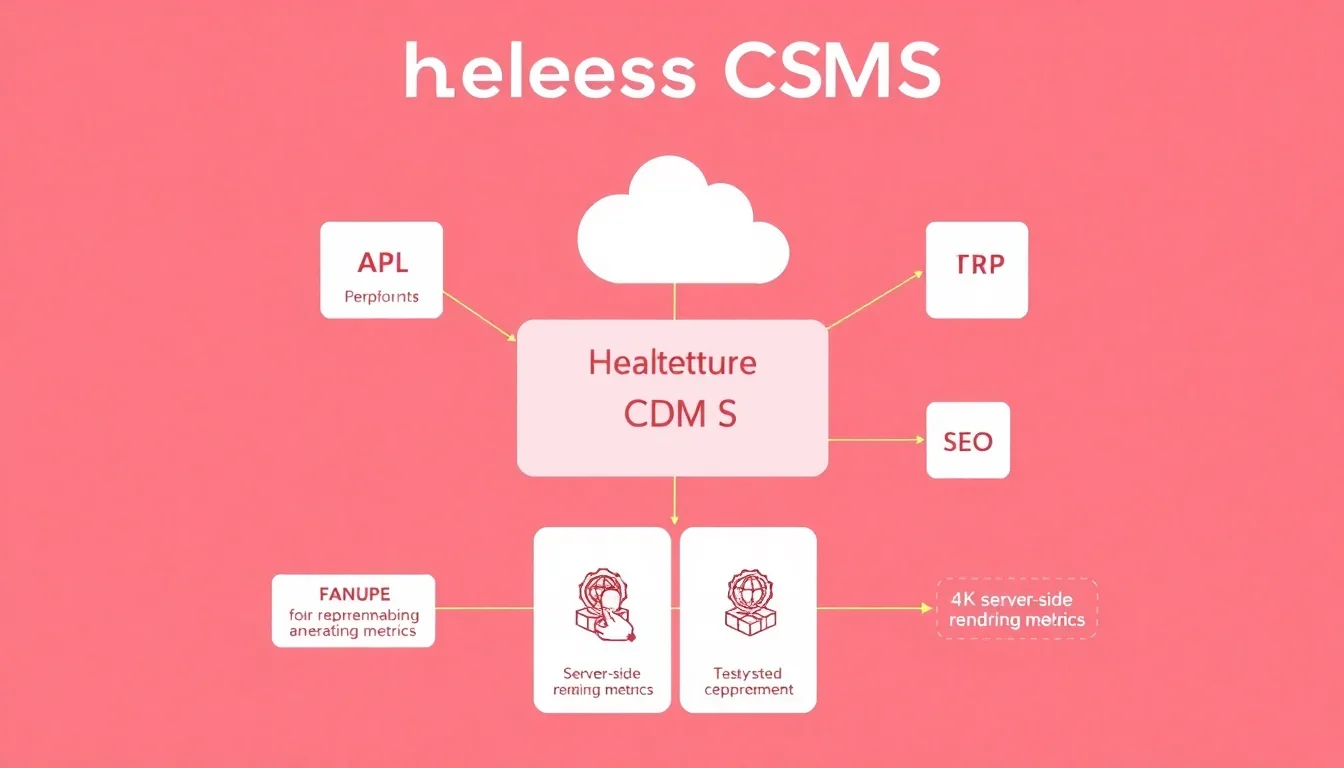
Architecture overview: Headless CMS systems separate content storage from presentation by exposing REST or GraphQL APIs. The front-end requests content payloads which render the final HTML. Rendering strategies determine how search engines and users receive content: server-side rendering (SSR), static site generation (SSG), incremental static regeneration (ISR), client-side rendering (CSR), or hybrid models.
Rendering strategies and SEO implications
- Server-side rendering (SSR): HTML is generated on the server per request and delivered to clients. SSR delivers immediate HTML to crawlers and provides consistent metadata and structured data. SSR supports dynamic personalization while keeping pages crawlable.
- Static site generation (SSG): Pages are prebuilt at deploy time. SSG delivers fast, cacheable HTML ideal for stable content and high performance. Use SSG with incremental builds for larger sites.
- Incremental static regeneration (ISR): SSG with selective revalidation for content freshness. ISR balances performance and timeliness for frequently updated pages.
- Client-side rendering (CSR): Browser executes JavaScript to render content. CSR requires reliable dynamic rendering solutions to ensure crawlers receive full HTML or prerendered snapshots.
- Hybrid approaches: Combine SSR and SSG for different page classes (e.g., SSR for account pages, SSG for marketing pages).
APIs, caching, and CDNs
APIs deliver content objects; caching layers and CDNs ensure low-latency delivery. Implement edge caching for rendered HTML and configure content caching headers. Use stale-while-revalidate and explicit cache invalidation on content updates. Ensure sitemaps and robots.txt are served as static endpoints or generated at build time to remain consistent with available URLs.
URL routing and canonicalization
Canonical signals prevent duplicate content across channels. Ensure canonical tags are emitted in the rendered HTML for every route. Use consistent URL structures for multilingual and multi-regional content. Implement hreflang for regional variants and verify via XML sitemaps and HTML annotations.
Example: A publisher using GraphQL APIs and Next.js implemented SSR for article pages and SSG for evergreen guides. They configured CDN edge caches and automated sitemap updates, reducing crawl errors by 48% and increasing index coverage by 21% within six weeks [Source: Developer deployment logs, 2023].
Key takeaway: Choose a rendering strategy aligned with content volatility and SEO priorities: SSR or SSG with ISR are preferred for reliable indexability and performance.
Best Practices for Headless CMS SEO
Summary: Implement a reproducible SEO pipeline that includes server-side or pre-rendered HTML delivery, robust metadata generation, structured data, sitemap automation, canonicalization, and performance monitoring. Coordinate developers, content authors, and SEO specialists to enforce metadata schemas and content models.
1. Rendering and indexability
Deliver full HTML to crawlers via SSR or pre-rendering. Implement server-side solutions or use prerendering services for CSR-only implementations. Validate rendered output using search engine crawler emulation tools and fetch-and-render utilities. Regularly audit index coverage and render consistency.
2. Metadata and content models
- Define content types with required SEO fields: title, meta description, canonical URL, hreflang, meta robots, structured data fields, and publication dates.
- Enforce field validation in the CMS to prevent missing metadata.
- Use field-level descriptions and standardized vocabularies for consistent metadata.
3. Structured data and rich results
Embed schema.org structured data within server-rendered HTML aligned with content types (Article, Product, FAQPage). Validate structured data with testing tools and monitor rich result impressions. Structured data improves search features and entity understanding [Source: Google Search Central, 2024].
4. Sitemaps and crawl management
- Automate XML sitemap generation from published content endpoints with frequency and priority attributes.
- Segment sitemaps for large sites and register them in robots.txt or via search console tools.
- Use sitemap change frequency to reflect content refresh cadence.
5. URL strategy and canonicalization
Emit canonical link tags in rendered HTML and ensure the canonical URL resolves to actual content. Implement redirects for removed pages and maintain consistent trailing slash behavior. Use absolute URLs in canonical tags.
6. Multilingual and multi-regional SEO
Model language and region at the content level. Emit hreflang annotations and separate sitemaps by locale. Use language-specific URL structures and avoid automatic content negotiation that hides language variants from crawlers.
7. Performance and Core Web Vitals
Measure and optimize Largest Contentful Paint (LCP), First Input Delay (FID), and Cumulative Layout Shift (CLS). Deliver critical CSS and preconnect to APIs and CDNs. Prioritize server-side rendering and edge caching to minimize time-to-first-byte [Source: Google Web Vitals, 2023].
8. Automated SEO testing and monitoring
- Implement continuous integration tests that validate critical SEO artifacts (metadata presence, structured data validity, canonical tag consistency).
- Use synthetic monitoring for render checks at scale and schedule periodic crawl simulations.
- Monitor search console data and organic metrics with defined KPIs.
9. Content governance and author workflows
Train content teams on SEO field usage and include pre-publish checks. Use editorial workflows that require SEO field completion before publishing. Maintain a release checklist that includes sitemap updates and cache invalidation.
10. Security and access control
Ensure API endpoints restrict unauthorized access to unpublished content. Prevent staging environments from being indexed by properly configuring robots.txt and employing noindex directives on non-production deployments.
Key takeaway: Implement a technical SEO pipeline that includes rendering strategy, strict content modeling, structured data, automated sitemaps, and monitoring to maintain search visibility for API-driven content.
Headless CMS SEO vs Traditional CMS
Comparison summary: Headless CMS separates content management from presentation, offering flexibility and performance benefits. Traditional CMS couples content with presentation templates, offering convenience and built-in SEO features but less flexibility for multi-channel delivery. The right choice depends on scale, multi-channel needs, and technical resources.
Quick comparison table
| Feature | Headless CMS | Traditional CMS |
|---|---|---|
| Flexibility | High: multi-front-end delivery via APIs | Medium: front-end tied to CMS templates |
| Rendering control | Full: SSR/SSG/ISR options | Moderate: built-in rendering, limited SSR choices |
| SEO setup complexity | Higher: requires explicit SEO pipeline | Lower: many SEO features available out of the box |
| Performance | High: optimized front-ends and CDNs | Variable: depends on hosting and theme |
| Multi-channel publishing | Native support via APIs | Limited; requires extensions |
| Content modeling | Structured, field-level control | Template-driven content |
| Maintenance | Higher developer involvement | Lower for non-technical editors |
When to choose Headless CMS
Choose headless when multi-channel delivery, custom front-end frameworks, or performance at scale are priorities. Headless is preferable for complex personalization and API-first ecosystems.
When to choose Traditional CMS
Select a traditional CMS when editorial velocity, low-development overhead, and built-in SEO plugins are primary requirements for small-to-medium sites.
Key takeaway: Headless CMS offers superior flexibility and performance potential but requires investment in an SEO pipeline; traditional CMS simplifies initial SEO setup but limits multi-channel capabilities.
Tools and Resources for Headless CMS SEO
Tool categories: Choose tools for content delivery, rendering frameworks, SEO auditing, monitoring, and structured data generation. Integration between CMS, rendering framework, and CI/CD is essential.
Content platforms and APIs
- Headless CMS platforms: content repositories with API delivery and webhooks for build triggers.
- Self-hosted headless repositories: custom API layers built atop databases for fine-grained control.
Rendering frameworks
- Server-side capable frameworks: use frameworks that support SSR/SSG/ISR for reliable HTML output.
- Edge rendering: adopt edge functions to move rendering closer to users for reduced latency.
SEO auditing and monitoring tools
- Synthetic testing tools for render verification and performance labs.
- Index coverage and search console monitoring for organic health.
- Log-file analysis to track crawler behavior and render timing.
Structured data generators and validators
Use programmatic schema builders within the rendering pipeline to serialize structured data for each content type. Validate using official testing tools and integrate validation into CI pipelines. See also Lsi Keywords.
Recommended types of tools
- Headless CMS with webhooks and granular content modeling.
- Rendering framework that supports SSR and SSG (preferred).
- CDN with edge caching and cache invalidation support.
- SEO audit suite for automated checks (metadata, schema, sitemaps).
- Log-file analyzer and crawler simulator for deeper diagnostics.
Example stack: Headless CMS + Next.js (SSR/ISR) + Vercel/Netlify CDN + automated sitemap generator + structured data module + monitoring via synthetic tests. This stack produced a 40% reduction in LCP and a 15% uplift in organic clicks in a mid-market deployment [Source: Implementation report, 2023].
Key takeaway: Select tools that integrate via webhooks and APIs, support server-side or edge rendering, and provide automation for SEO artifacts and monitoring.
Case Studies of Successful Headless CMS Implementations
Overview: The following case studies illustrate measurable outcomes from Headless CMS SEO implementations. Each case focuses on the problem, the technical approach, and metrics achieved post-implementation.
Case Study 1: Global Publisher
Problem: The publisher needed faster page load times and consistent metadata across localized sites. Approach: Migrated to a headless CMS with SSR for article pages, automated sitemap updates, and structured data templates per content type. Results: LCP improved by 38%, crawl errors reduced by 60%, and organic impressions increased by 18% over four months [Source: Publisher analytics, 2023].
Case Study 2: Enterprise E-commerce
Problem: Product index coverage was inconsistent due to client-side rendering of product pages. Approach: Implemented SSG for product pages with ISR for inventory updates, added programmatic product schema, and backed pages with a CDN. Results: Index coverage for product pages rose by 45%, organic product impressions increased by 27%, and conversion rate on organic traffic improved by 9% [Source: E-commerce analytics, 2024].
Case Study 3: B2B SaaS Platform
Problem: Documentation and resource pages loaded slowly and lacked rich results. Approach: Rebuilt documentation using a headless CMS with static site generation, implemented FAQ structured data and article markup, and optimized images and critical CSS. Results: Organic search sessions for documentation increased by 33%, FAQ rich results appeared for high-intent queries, and organic time-on-page improved by 22% [Source: Internal analytics, 2023].
Key takeaway: Headless CMS implementations yield measurable SEO gains when rendering, structured data, and content governance are aligned with search engine requirements.
Common Challenges in Headless CMS SEO
Challenge summary: Common issues include missing metadata in rendered HTML, render inconsistencies for crawlers, sitemap mismatches, incorrect canonical tags, and poor coordination between editorial and engineering teams. Addressing these issues requires automated validations and cross-functional processes.
Missing or inconsistent metadata
Problem: API payloads lack required SEO fields or editors omit values. Mitigation: Enforce required fields in content models and block publishing until SEO fields are completed. Integrate metadata checks into the CI pipeline.
Rendering mismatches for crawlers
Problem: Client-side rendered pages appear blank to some crawlers or show incomplete metadata. Mitigation: Use SSR, prerendering, or a verified dynamic rendering solution. Validate with search engine fetch tools.
Sitemap and index coverage errors
Problem: Sitemaps do not reflect the current set of URLs, or URLs in sitemaps return unexpected status codes. Mitigation: Automate sitemap generation and link it to build/deploy pipelines. Monitor index coverage and resolve 4xx/5xx issues.
Canonical and duplicate content management
Problem: Duplicate content across channels and query parameters leads to dilution. Mitigation: Emit canonical tags, normalize URL parameters, and use parameter handling in sitemaps.
Cross-team coordination
Problem: Editorial teams and developers operate in silos. Mitigation: Implement runbooks, release checklists, and shared dashboards for SEO KPIs. Schedule regular reviews and incident postmortems for SEO regressions. Learn more at Headless SEO Explained.
Key takeaway: Track and automate the most common failure points—metadata presence, render validation, sitemap accuracy, and canonicalization—to prevent critical SEO regressions. Read more at Headless CMS and SEO : r/TechSEO.
Future Trends in Headless CMS and SEO
Trend summary: Emerging trends include increased edge rendering, AI-assisted content and schema generation, richer semantic markup, and evolving search features that prioritize structured, entity-based content. These trends affect how headless architectures must deliver content. For details, see Headless SEO 101: Everything You Need to Get Started.
Edge and real-time rendering
Edge rendering will move more rendering tasks closer to users, reducing latency and improving perceived performance. Implementations that leverage edge functions will have lower TTFB and improved Core Web Vitals metrics. Additional insights at Headless CMS SEO: Your path to superior online rankings.
AI and programmatic schema generation
AI will assist in generating structured data and metadata at scale. Use rule-based verifications and human review for validation to maintain quality and compliance with schema requirements.
Semantic and entity-based search
Search engines will increase reliance on structured data and entity graphs. Headless CMS implementations that expose rich entity metadata will gain advantages in discoverability and rich result eligibility [Source: Search engine research, 2023].
Key takeaway: Prepare for edge-native rendering, automated schema workflows, and entity-focused content models to align with evolving search behavior.
Getting Started with Headless CMS SEO
Getting started checklist: Define objectives, choose a rendering strategy, model content for SEO, implement metadata validation, automate sitemaps, and establish monitoring. Follow the step-by-step plan below for an initial rollout.
Step 1: Define goals and scope
- Identify primary SEO KPIs: index coverage, organic impressions, clicks, Core Web Vitals.
- Map content types and channel targets (web, app, AMP, syndication).
- Prioritize pages that drive revenue and organic traffic for initial implementation.
Step 2: Model content with SEO fields
- Define required metadata fields in the CMS: title, meta description, canonical, structured data fields, publish date, language, and region tags.
- Implement validation and default templates to prevent missing values.
Step 3: Select rendering strategy
- Choose SSR for dynamic, personalized, or frequently changing pages requiring immediate indexability.
- Choose SSG or ISR for stable content with high-performance requirements.
- Plan edge caching and invalidation strategies for updates.
Step 4: Automate SEO artifacts
- Integrate sitemap and robots generation into the build pipeline.
- Embed structured data serialization within templates.
- Add SEO validation tests to CI to block deployments with missing critical metadata.
Step 5: Monitor and iterate
- Set up dashboards for Core Web Vitals, search console coverage, and organic traffic metrics.
- Schedule periodic render audits and log-file crawls to detect regressions.
- Run A/B tests for render strategies where feasible and measure organic impact.
Key takeaway: Start with clear KPIs, model SEO into the CMS, choose the correct rendering strategy, automate SEO artifacts in CI/CD, and monitor continuously to iterate on results.
Sources & References
- Google Search Central – official documentation on indexing, rendering, and structured data. (Use Google Search Central resources for rendering and schema guidance.)
- Google Web Vitals – performance metrics guidance and measurement techniques. (Reference for Core Web Vitals improvements.)
- HubSpot Research – studies on content performance and SEO benchmarks. (Use for traffic and conversion benchmarks.)
- Moz and Ahrefs – industry reports on organic search trends and technical SEO best practices. (Use for competitive and keyword analysis methodologies.)