how to post article [2026]: 7 Simple Steps to Publish
Answer: how to post article is the process of preparing, formatting, and publishing written content to a CMS or hosted platform, including headings, images, metadata, visibility settings, and scheduling to make the content discoverable, for search engines.
Table of Contents
Publishing a high-quality article involves more than pasting text into an editor. This guide explains an efficient, repeatable workflow that reduces errors, prevents visibility issues, and improves indexing. You will get platform micro-guides for WordPress, Medium, and LinkedIn, a practical SEO checklist, image optimization tips, publishing settings guidance, and troubleshooting. Like many new creators, you worry about visibility; I’ve published dozens of posts across WordPress and Medium and share concise actions you can apply immediately. Here’s my honest take: schedule posts during your audience’s daytime to improve early engagement and indexing signals.
Quick Overview — How to Post Article
How to post article refers to preparing, formatting, and publishing content so it is readable and discoverable on a website or publishing platform. The core goal is to publish content that users and search engines can access and understand.
- What you’ll accomplish: prepare a searchable draft, optimize media and metadata, publish with the correct visibility, and promote for initial traffic.
- What you’ll avoid: private posts, missing images, duplicate content, and indexing blockers.
- Outcome: a published article ready for indexing and sharing.
Read time estimate: 7 minutes
Step-by-Step: How to Post Article
Each step below links to a focused section with practical checklists and platform examples.
Step 1
Prepare content: title, intro, headings, images, and references.
Step 2
Format and add images/links for scannability and accessibility.
Step 3
Add SEO metadata: title tag, meta description, canonical, categories/tags.
Step 4
Upload to CMS and set publish options (visibility, schedule, canonical).
Step 5
Publish and promote: social shares, sitemap ping, and monitor performance.
Each step below links to a focused section with practical checklists and platform examples.
How to Post Article: Step 1 — Prepare Your Article
Draft a clear headline and intro
Write a concise headline and an immediate-value intro that includes the primary keyword in the first paragraph. The headline should be 50–70 characters where possible and communicate user intent. Open with the primary keyword naturally, then support it with a brief problem-statement and solution preview.
Structure using H2/H3 headings for scannability
Organize content into logical H2 and H3 sections with short paragraphs and bullet lists. Use H2 for major sections and H3 for subsections. Readers and search engines scan headings to understand content hierarchy; include keyword variations in 2–3 subheadings without stuffing.
Create or source featured image
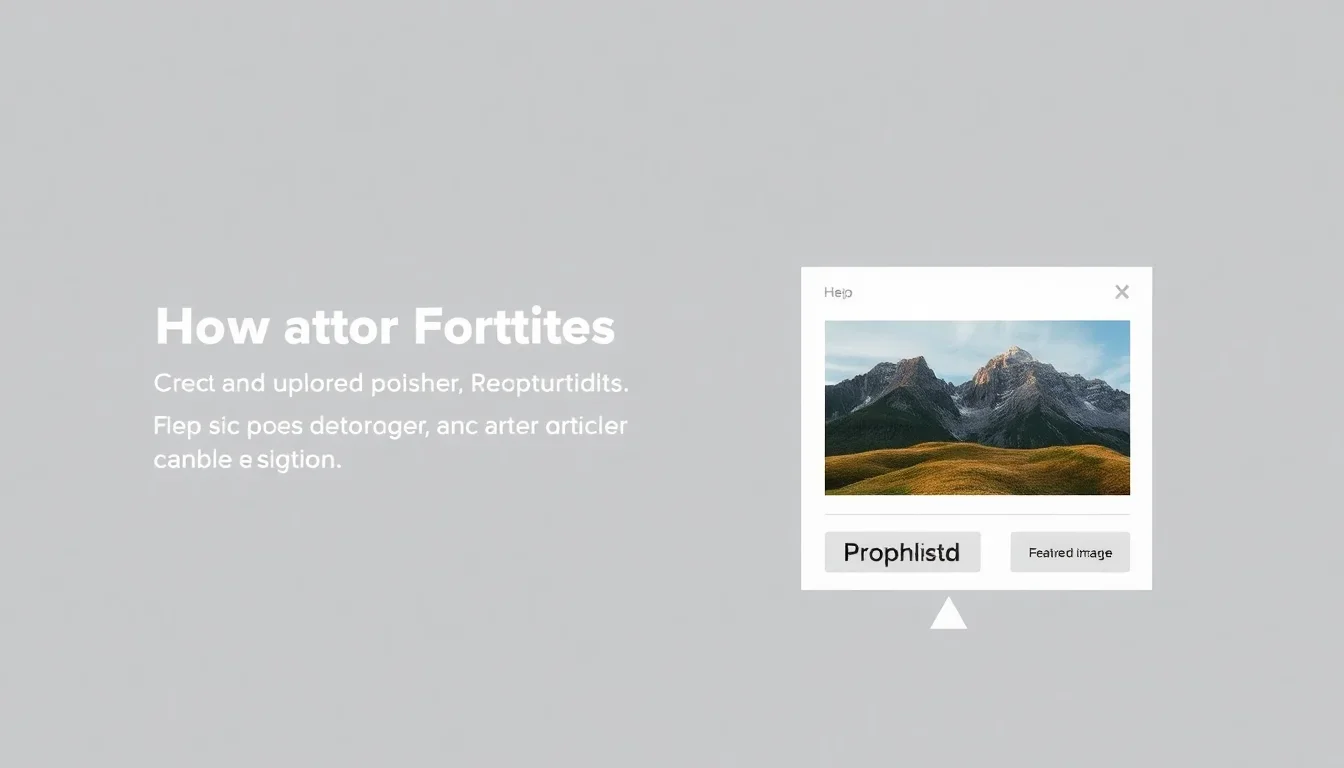
Select a featured image that matches the article topic and fits common aspect ratios (1200×630 px recommended). Compress to under 100KB in WebP format and prepare an alt text that includes a keyword variation and describes the visual content precisely.
- Pre-upload checklist: proofread, verify facts, confirm image licenses, collect source attributions, and export headings outline.
- Confirm accessibility: add alt text and captions where helpful.
How to Post Article: Step 2 — Format & SEO
how to post article SEO checklist
Place the target keyword in the title tag, first paragraph, an H2 or H3, and in the meta description. Use a meta description of 110–155 characters that summarizes value and includes the keyword. Add structured data where applicable and set a canonical URL to prevent duplicate content.
how to post article with images (alt text, compression, captions)
Optimize images by compressing to WebP under 100KB, using descriptive file names, and adding semantic alt text that contains a keyword variation. Use captions sparingly to add value. Lazy-load images for performance and include width/height attributes when possible.
add internal and external links
Add 2–4 internal links to relevant pages and 1–2 authoritative external references. Use descriptive anchor text that reflects the target page’s topic. Avoid generic anchors like “click here.” Check every link for correctness before publishing.
SEO essentials (snippet-ready): Focus on a single primary keyword, use it in the title and first paragraph, add a concise meta description, optimize images and headings, and implement canonical tags and structured data to support indexing and rich results. See also Contextual Signals.
How to Post Article: Step 3 — Upload, Configure & Publish
Upload process overview (copy/paste vs import)
Copy-paste works for short posts; use import tools or CMS-specific import plugins for larger archives to preserve formatting and metadata. Validate formatting after paste: check headings, code blocks, lists, and images.
Visibility settings (public, private, password-protected)
Choose public for immediate indexing, private for drafts or internal reviews, and password-protected for gated content. Public posts are crawlable by search engines; private and password-protected posts block indexing unless you explicitly allow it.
Scheduling posts and timezone considerations
Schedule using your site timezone to align with audience active hours. Verify server and CMS timezone settings before scheduling. For international audiences, publish during the largest segment’s daytime window to maximize early engagement.
Publish settings comparison
| Option | What it does | When to use |
|---|---|---|
| Public | Visible to everyone; indexed by search engines | Standard for finished articles |
| Private | Visible only to logged-in users or admins | Drafts, internal reviews |
| Password-protected | Requires password to view; generally not indexed | Gated content or tests |
| Scheduled | Publishes at set date/time | Timed launches for audience peaks |
Pro tip: set the canonical URL before publishing and confirm robots.txt does not disallow the post path. Use Google Search Console to request indexing for priority pages.
How to Post Article on Popular Platforms
how to post article on WordPress
On WordPress, create a new Post, add the title and paste or write content in blocks, set a featured image, configure excerpt and categories/tags, add SEO metadata via your SEO plugin, and choose Publish or Schedule. Use the preview option to verify layout across devices.
- Dashboard → Posts → Add New.
- Enter title and content using Gutenberg blocks.
- Upload featured image and set alt text.
- Set categories and tags.
- Set SEO fields in Yoast/RankMath (title tag, meta description).
- Publish or Schedule with visibility settings.
how to post article on Medium
Medium’s editor is minimalist: start a new story, add a title and subtitle, paste content, insert images using the plus button, add tags (up to five), and click Publish. Medium handles canonicalization differently; use the import tool if republishing to preserve attribution. Learn more at Google Search Central overview for indexing and content best practices.
- Create New Story → Add title and subtitle.
- Paste content and format in the WYSIWYG editor.
- Insert images and captions.
- Select up to five tags and Publish.
how to post article on LinkedIn
On LinkedIn, open the publishing tool (Write an article), add a headline, paste content, include a cover image, and click Publish. Use short paragraphs and add internal links to your company or post pages for cross-traffic. Read more at Moz guide on content optimization and on-page SEO.
- Go to LinkedIn Home → Write an article.
- Add headline, cover image, and body content.
- Add multimedia where relevant and Publish.
how to post article on Blogger / Wix
Blogger and Wix use WYSIWYG editors: create a new post, add title and content, upload images, configure SEO fields where available, and publish. Check platform-specific help pages for canonical and sitemap behavior.
Tools & Resources
- Text editors: Google Docs (free), Microsoft Word (paid).
- CMS options: WordPress.org (self-hosted), Medium (hosted), Ghost (paid self-hosted/cloud).
- Image optimization: TinyPNG (free/paid), Squoosh (free).
- SEO plugins: Yoast SEO (free/paid), Rank Math (free/paid).
- Publishing automation: Buffer (paid), Hootsuite (paid), native scheduling in WordPress.
- Monitoring: Google Search Console (free), Google Analytics (free), Ahrefs/SEMrush (paid).
Pricing notes: WordPress hosting varies widely—shared hosting starts around USD 3–10/month; managed WordPress can start at USD 20/month. Free alternatives exist for most tools listed above. Use Google Search Console to verify indexing without cost.
Recommended templates: create a reusable post checklist (title, intro, headings, images, SEO fields, publish settings) and export it as a PDF for your team.
Common Mistakes & Troubleshooting
- Not setting visibility: Fix by verifying the publish status and visibility before exiting the editor.
- Missing alt text: Fix by adding descriptive alt text that includes a keyword variation and describes the image.
- Broken images: Fix by re-uploading images, using absolute URLs when necessary, and checking file permissions.
- Duplicate content: Fix by setting canonical tags and using rel=canonical when reposting.
- Wrong timezone scheduling: Fix by confirming the site and server timezone settings before scheduling.
- Poor headings and structure: Fix by adding H2/H3 hierarchy and concise subheadings for clarity.
- Forgetting to submit sitemap: Fix by pinging search engines or submitting the updated sitemap in Google Search Console.
Quick troubleshooting tip: replicate the issue in a private browser window, test with different user accounts, and consult platform support if the issue persists.
FAQ
How long does it take to post an article?
Answer: Posting a basic article can take 10–30 minutes; a fully optimized article typically requires 1–3 hours. Time depends on research, image preparation, SEO metadata, and CMS familiarity. Allocate more time for multi-author review and multimedia-heavy posts.
Can I post the same article on Medium and my blog?
Answer: Yes, you can repost content, but use canonical tags or Medium’s import tool to signal original attribution. Without canonicalization, duplicate content can split indexing signals. Prefer cross-posting with canonical pointing to your primary URL when owning the original.
How do I add images when I post an article?
Answer: Upload images via the editor’s media manager or drag-and-drop interface, add descriptive file names and alt text, and compress to WebP under 100KB. Use captions for context and verify responsive display in preview mode.
How do I schedule an article to publish later?
Answer: Set the publish date/time in the CMS publish panel and confirm the site timezone. Use scheduling for audience peak times and ensure server time aligns with CMS timezone to prevent timing errors.
Will my article be indexed by Google after publishing?
Answer: Public articles are typically crawled within hours to days; indexing depends on site authority and crawl frequency. Request indexing via Google Search Console for priority pages and ensure noindex tags or robots.txt rules block crawlers.
How do I fix a published article with errors?
Answer: Edit the post, correct content, update metadata, and republish or save as updated. If errors affect search results, update the content and request reindexing in Google Search Console. Use version history to revert if needed.
Do I need to add canonical tags when reposting?
Answer: Yes, add canonical tags to indicate the preferred source and prevent duplicate content. When reposting on platforms like Medium, use their import tool to set canonical links automatically or add rel=canonical to the original page.
How to post article with affiliate links?
Answer: Disclose affiliate relationships clearly, use rel=”nofollow” or rel=”sponsored” where appropriate, and avoid excessive affiliate links. Ensure affiliate destinations are trustworthy and that links do not break the user experience.
How to post article for multiple authors?
Answer: Use CMS features for co-authors or add author bylines and contributor bios within the content. In multi-author workflows, assign roles and use editorial plugins to manage drafts, revisions, and publication approvals.
Best image size when you post an article?
Answer: Aim for 1200×630 px for featured images and compress to under 100KB in WebP format. For inline images, use appropriate dimensions for the layout and responsive sizes to serve smaller images to mobile devices.
Sources & References
- WordPress.org support documentation — Writing Posts (WordPress.org)
- Medium Help Center — Publishing and Formatting (Medium)
- LinkedIn Help — Publish Articles (LinkedIn)
- Google Search Central — Indexing and Crawling (Google)
- HubSpot research and blogging benchmarks — Content performance insights (HubSpot)
Conclusion
Key takeaways: follow the five-step process—prepare, format, add SEO, upload/configure, publish & promote; use an SEO checklist for metadata and images; verify publish settings (canonical, visibility, scheduling) to avoid indexing issues. Implement the 5-step checklist and schedule your first publish within 48 hours. Start with a clear headline, include optimized images and metadata, and use platform-specific publish settings to control visibility. Track performance in Google Search Console and iterate based on engagement metrics. By following a repeatable workflow, you reduce publishing errors and improve discoverability for readers and search engines. Last Updated: 2026-01-15