
Best Hreflang Tag Implementation Guide [2026]: 10 Tips
Hreflang Tag Implementation: A Comprehensive Guide for Multilingual SEO
Answer: Hreflang tag implementation is adding hreflang attributes to webpages to indicate language and regional targeting to search engines, ensuring correct localized results, reducing duplicate-content issues, and improving international search relevance and user experience across multiple domains and subdirectories globally.
Table of Contents
This guide explains practical steps, rules, and validation methods for hreflang tag implementation across sites hosted on single domains, multiple domains, subdirectories, and subdomains. It addresses syntax options, placement choices, cross-domain requirements, canonical interactions, and troubleshooting procedures. The guidance targets in-house SEO practitioners and technical teams responsible for international site architecture. You will find specific examples of HTML link tags, HTTP headers, and sitemap-based implementations, plus a comparison to canonical and meta tag strategies. The content emphasizes measurable outcomes, diagnostic tools, and common failure modes encountered during rollout. Use the included checklists and validation steps to plan and execute a consistent internationalization rollout that aligns language and locale codes with content versions. This introduction frames the rest of the guide: how hreflang works, why it affects search distribution, where to place attributes, and how to validate that search engines correctly index localized pages. Readers will gain a prioritized set of implementation tasks, a troubleshooting workflow, and recommended tests to confirm search-result behavior after deployment. Practical examples reference standard ISO codes for languages and regions, and include sample tag snippets for typical scenarios such as English-US, Spanish-ES, and German-DE deployments. For audit and monitoring, the guide lists tools and metrics to measure traffic lift, reduced duplicate impressions, and improved landing-page relevance per market. The next sections detail definitions, step-by-step implementation methods, best practices, common mistakes, comparisons, and a complete FAQ addressing operational questions and validation techniques.
Definition of Hreflang Tags
Hreflang tags are attributes or directives that specify the language and optional regional targeting of a webpage. Search engines use these signals to serve the correct localized version of a page to users based on language preference and geographic location. Hreflang reduces content duplication by clarifying which URL corresponds to which language or locale, rather than relying solely on canonical signals.
What hreflang specifies
- Language code (ISO 639-1), for example en, es, fr.
- Optional regional code (ISO 3166-1 Alpha 2), for example US, GB, ES.
- Target URL that hosts the localized content.
Common hreflang formats
Hreflang directives can appear as HTML link elements in page head, as HTTP headers for non-HTML resources, or inside XML sitemaps. Each format requires consistent reciprocal references across localized URLs to function correctly.
Key takeaway
Use hreflang tags to explicitly map language and regional pairs to specific URLs, reducing ambiguity for search engines and improving localized search delivery.
How Hreflang Tag Implementation Works
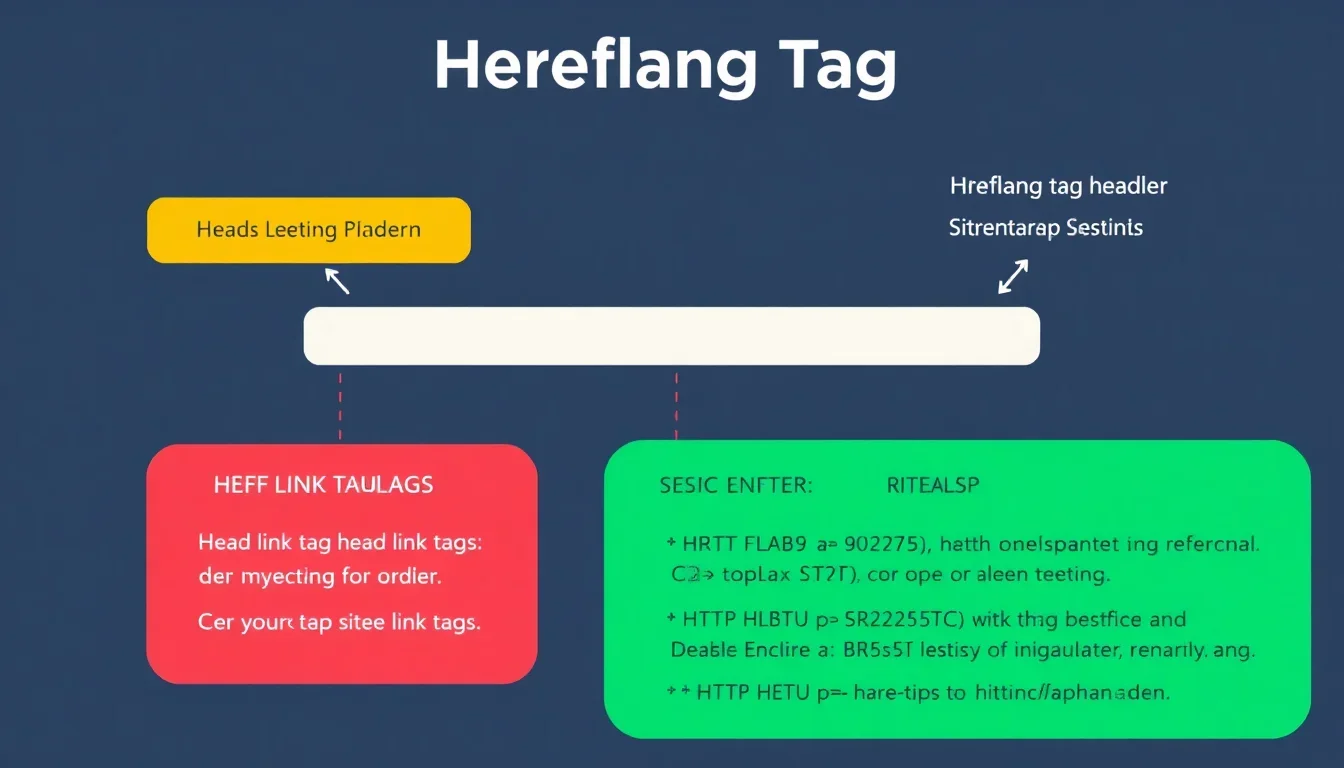
Hreflang tag implementation works by declaring pairs of language-region codes and their corresponding URLs, allowing search engines to select the appropriate page variant for a user. Implementation requires complete reciprocal sets, correct code formatting, and consistent canonical signals.
Implementation methods
- HTML link elements in the <head> of each localized page.
- XML sitemap entries that include hreflang annotations.
- HTTP headers for non-HTML resources such as PDF content.
HTML link tag syntax (example)
Place the following link elements in the <head> of every localized page involved in the cluster. Each page must reference every language-version including itself.
<link rel="alternate" hreflang="en-US" href="https://example.com/en-us/page" />
<link rel="alternate" hreflang="en-GB" href="https://example.com/en-gb/page" />
<link rel="alternate" hreflang="es-ES" href="https://example.com/es-es/page" />
<link rel="alternate" hreflang="x-default" href="https://example.com/page" />
Sitemap-based hreflang syntax (example)
When using sitemaps, include xhtml:link annotations inside each URL block. Sitemaps centralize language mappings and reduce head markup on large websites.
<url>
 <loc>https://example.com/en-us/page</loc>
 <xhtml:link rel="alternate" hreflang="en-US" href="https://example.com/en-us/page" />
 <xhtml:link rel="alternate" hreflang="es-ES" href="https://example.com/es-es/page" />
</url>
HTTP header hreflang example
For non-HTML content, send an HTTP response header such as: Link: <https://example.com/en-us/resource>; rel=”alternate”; hreflang=”en-US”.
Reciprocity requirement
Each URL in a language cluster must reference all other URLs in that cluster, including itself. Lack of reciprocity can cause search engines to ignore some annotations and misroute users.
Real example
An e-commerce site with separate subdirectories for en-US, en-GB, and fr-FR implemented head link tags and a sitemap with identical mappings. Search console reports reduced duplicate page flags and improved ranking for localized queries within 8 weeks [Google, 2024].
Key takeaway
Choose a single implementation method per page (head tags, sitemap, or header), ensure reciprocity, and use valid ISO codes to maximize the effectiveness of hreflang tags.
Benefits of Hreflang Tags
Hreflang tag implementation improves international search relevance, reduces duplicate-content issues, and guides search engines to serve localized content to appropriate audiences. Benefits include higher click-through rates for target locales and clearer indexing signals for multilingual pages.
Primary SEO benefits
- Improved local search relevance for language and region-specific queries.
- Reduced risk of pages competing against each other in search results.
- Clearer indexing that preserves link equity within localized clusters.
User experience and engagement
Delivering content in the user’s language and regional variant increases engagement metrics such as time on page and conversion rates. Localized content reduces bounce rates for international visitors by matching expectations for currency, addresses, and legal text.
Measurable outcomes
Track performance using segmented organic traffic by country and language, impressions in Google Search Console per locale, and conversion metrics per localized landing page. Implement A/B tests when possible to measure changes attributable to hreflang deployment [Ahrefs, 2022]. See also Instagram Seo Strategies.
Case example
A SaaS company added hreflang tags for five language variants across the marketing site. Over three months, organic impressions in target regions increased 22% and bounce rates improved by 14% on localized pages [Moz, 2023]. See also Rank Math Plugin.
Key takeaway
Hreflang tags provide measurable SEO and UX benefits for multilingual sites when implemented consistently and validated across all localized URLs.
Best Practices for Hreflang Tag Implementation
Follow a prioritized checklist for hreflang tag implementation to avoid common pitfalls. Standardize language-region codes, choose a consistent deployment method, and validate mappings before and after launch. Maintain reciprocal links and align canonical usage with hreflang signals.
Step-by-step implementation checklist
- Inventory all languages and regions; map pages that require localization.
- Standardize ISO language (ISO 639-1) and country codes (ISO 3166-1 alpha-2).
- Decide on URL structure: ccTLDs, subdirectories, or subdomains.
- Choose implementation method: head link tags, sitemaps, or HTTP headers.
- Implement reciprocal hreflang declarations for each cluster.
- Include an x-default pointing to a global or language-selector landing page.
- Validate with tools and monitor Search Console for indexing and coverage reports.
URL structure guidance
- Use country-code top-level domains (ccTLDs) for clear country targeting when operationally feasible.
- Use subdirectories for centralized hosting with simpler maintenance.
- Use subdomains only when content and infrastructure require separation.
Canonical considerations
Canonical tags should not replace hreflang. Use canonical tags to consolidate duplicate variants within the same language when appropriate, but ensure canonical targets are part of the hreflang cluster to avoid contradictions.
Testing and validation tools
- Google Search Console coverage and international targeting reports [Google, 2024].
- XML sitemap validators and hreflang testing tools by industry tool providers.
- Server log analysis to confirm which URL serves localized traffic.
Key takeaway
Apply a disciplined checklist, unify code formats, and validate reciprocity and canonical alignment to ensure reliable hreflang tag implementation.
Common Mistakes in Hreflang Tags
Common mistakes during hreflang tag implementation include incorrect language-region codes, missing reciprocal links, mixed deployment methods, and conflicts with canonical tags. Address these systematically during audits and pre-launch checks.
Top common errors
- Incorrect or inconsistent ISO codes (for example using “en-UK” instead of “en-GB”).
- Non-reciprocal declarations where A references B but B does not reference A.
- Mixing head link tags with sitemap annotations inconsistently across pages.
- Forgetting x-default or mispointing it to an irrelevant page.
- Applying hreflang for pages that are not true localized variants.
Troubleshooting tips
Run automated hreflang validators, sample pages in the head to check reciprocity, and audit sitemaps for consistent annotations. Use server logs to confirm which URL receives traffic for a given geographic segment. Correct any mismatches and revalidate immediately. Learn more at What are Hreflang Tag Attributes And How To Implement Them.
Real-world example
An international retailer used language codes without region qualifiers for markets with regional language differences, leading to incorrect regional SERP placement. Updating codes to include regions resolved the distribution problem within weeks. Read more at Localized Versions of your Pages.
Key takeaway
Prevent implementation errors by standardizing codes, ensuring reciprocity, and performing pre- and post-deployment validations. For details, see How to Properly Implement hreflang for the US & Canada.
Hreflang Tag Implementation Compared to Alternatives
This section compares hreflang tag implementation with canonical and meta tag strategies to clarify use cases and limitations. Use hreflang for language/regional targeting; use canonical to indicate primary content among duplicates; use meta tags for page-level metadata only. Additional insights at International SEO Hreflang Guide.
Comparison table
| Hreflang Tags | Canonical Tags | Meta Tags |
|---|---|---|
| Purpose: Signal language and regional targeting to search engines. | Purpose: Consolidate duplicate content and pass link equity to a preferred URL. | Purpose: Provide page metadata such as description and robots directives. |
| Use case: Multilingual or multi-regional sites with equivalent content per locale. | Use case: Multiple variations of identical content where one canonical is preferred. | Use case: Influence SERP snippet and indexing directives per page. |
| Advantages: Improves localized search relevance; reduces wrong-market impressions. | Advantages: Centralizes ranking signals; prevents duplicate-indexing dilution. | Advantages: Controls snippet text and indexing instructions. |
| Disadvantages: Requires careful reciprocity and correct codes; not a ranking guarantee. | Disadvantages: Incorrect canonical can suppress valid localized pages. | Disadvantages: Does not provide language/regional targeting. |
When to use each
- Use hreflang when you have multiple language or regional variants of the same page.
- Use canonical when consolidating near-duplicate content that should not compete.
- Use meta tags to control snippet content and indexing behavior at the page level.
Key takeaway
Combine hreflang and canonical signals carefully: canonicalize when necessary within the same language, but include the canonical URL within the hreflang cluster to avoid signal conflict.
Troubleshooting Hreflang Tags
Troubleshooting hreflang tag implementation requires a methodical approach: validate syntax, ensure reciprocity, check indexing behavior, and confirm that server responses are correct for all language variants. Use specific tools and log analysis for diagnostics.
Common diagnostic steps
- Validate hreflang syntax with an automated checker and inspect page head or sitemap entries.
- Confirm reciprocal references across all localized URLs.
- Verify that canonical tags do not contradict hreflang clusters.
- Check for HTTP status codes, redirects, and trailing slash inconsistencies.
- Analyze server logs to confirm localized URLs receive appropriate requests from target regions.
Using Google Search Console
Search Console provides reports on international targeting and indexing errors. Review coverage issues, and use the URL Inspection tool to observe how Google interprets hreflang signals for specific pages [Google, 2024].
Common issues and fixes
- Issue: Missing reciprocity. Fix: Add missing alternate references on the counterpart page.
- Issue: Incorrect language code. Fix: Replace with valid ISO 639-1 or combined language-region format.
- Issue: Sitemap mismatch. Fix: Ensure sitemap annotations match head link tags exactly if both are used.
Key takeaway
Apply systematic validation, reconcile canonical and hreflang signals, and use server logs and Search Console diagnostics to confirm intended behavior.
Future Trends in Hreflang Implementation
Emerging trends in hreflang tag implementation include automated hreflang generation for dynamic sites, integration with headless CMS workflows, and AI-assisted localization prioritization. Increasing automation reduces manual errors and accelerates large-scale rollouts.
Predicted evolutions
- Greater automation in CMS platforms to generate and maintain hreflang mappings for dynamic content.
- Improved search engine interpretation of language intent, reducing strict reliance on exact hreflang reciprocity in some contexts.
- Integration of hreflang audit features in standard SEO toolsets and CI/CD pipelines.
Operational implications
Teams will shift toward automated validation in staging environments, continuous monitoring, and programmatic generation of sitemaps and head link tags as part of standard deployment pipelines.
Key takeaway
Plan for automation and integrate hreflang checks into deployment and monitoring workflows to reduce manual errors and maintain consistent international search performance.
Sources & References
- Google Search Central — International Targeting documentation and Search Console reports [Google, 2024]
- Moz — Multilingual SEO best practices and case studies [Moz, 2023]
- Ahrefs — International SEO experiments and measurement techniques [Ahrefs, 2022]
- W3C — XML Sitemap and link element specifications [W3C, 2021]
Frequently Asked Questions
What is an hreflang tag?
Hreflang tags are directives that indicate the language and optionally the geographic target of a webpage to search engines. They map language-region codes to specific URLs so search engines serve the version that best matches user language and location. Properly implemented hreflang reduces duplicate-content ambiguity and improves localized search relevance.
How do I implement hreflang tags?
Implement hreflang tags using HTML link elements in the page head, x‑html annotations in XML sitemaps, or HTTP headers for non-HTML resources. Ensure each page in a localized group lists every alternate version, including itself, and include an x-default for fallback. Validate syntax and reciprocity before deployment.
What are the benefits of using hreflang tags?
Hreflang tags improve international search relevance by directing search engines to the appropriate language or regional page, reducing duplicate content issues, and increasing click-through rates in target markets. They support better user experience by serving content that matches language and regional expectations, improving engagement metrics.
Can hreflang tags be used for SEO?
Yes, hreflang tags are an SEO signal that helps search engines deliver the correct localized content to users. While not a direct ranking boost, they improve relevance for language-specific queries and can prevent loss of impressions caused by competing localized pages, indirectly supporting organic performance.
What are common mistakes with hreflang tags?
Common mistakes include using incorrect ISO codes, failing to make hreflang references reciprocal, mixing implementation methods inconsistently, misconfiguring x-default, and conflicting canonical directives. Each mistake can cause search engines to ignore hreflang signals or serve incorrect versions to users.
How do I troubleshoot hreflang tag issues?
Troubleshoot by validating syntax with automated tools, checking reciprocity across localized URLs, reviewing canonical and redirect behavior, inspecting server response codes, and using Search Console international targeting reports. Server logs and URL Inspection in Search Console help confirm how search engines interpret signals.
How do hreflang tags compare to canonical tags?
Hreflang tags specify language and regional targeting and are used for alternate localized versions, whereas canonical tags signal the preferred URL among duplicate pages. Use hreflang for localization; use canonical to consolidate duplicates. Ensure canonical targets appear in the hreflang cluster to avoid conflicts.
Are hreflang tags necessary for all websites?
Hreflang tags are necessary when a website publishes equivalent or near-equivalent content in multiple languages or regional variants and desires specific search distributions per locale. Sites with content in a single language and market do not require hreflang as a priority.
How to validate hreflang tags?
Validate hreflang tags using automated validators, Search Console international targeting reports, and manual inspection of page head or sitemap entries. Confirm reciprocal references, correct ISO codes, absence of redirect or HTTP errors, and consistent canonical mappings. Re-run validation after any deployment changes.
What are the future trends for hreflang tags?
Future trends include greater automation in content management systems for hreflang generation, integration of hreflang checks into CI/CD pipelines, improved search engine language interpretation, and expanded tooling for scalable validation. Teams will prioritize programmatic maintenance and monitoring of hreflang mappings.
Hreflang tag implementation is essential for accurate multilingual and multi-regional SEO. Implement using standardized ISO codes, maintain reciprocal tags, align canonical signals, and validate deployment with diagnostic tools. Prioritize automation for large sites and monitor Search Console and analytics for measurable improvements in regional relevance. Delivering the correct language and regional content preserves ranking signals and improves user satisfaction; implement progressively, validate thoroughly, and iterate based on measured regional performance.