Best Keyword Placement Tips for SEO for You [2026]
Answer: Keyword placement tips define strategic keyword positioning across titles, headings, meta elements, URLs, and body content to match user intent, improve search relevance, and increase organic visibility using contextual, semantic, and user-focused optimization techniques for measurable ranking gains, engagement metrics.
Table of Contents
Keyword Placement Tips: Introduction to Keyword Placement
Keyword placement refers to the deliberate positioning of search phrases within content elements to maximize relevance and visibility in search engines. Effective keyword placement aligns target phrases with user intent, structural signals, and content context to signal topical authority to search algorithms and to aid user comprehension.
This guide covers keyword research fundamentals, specific placement strategies for titles, headings, meta descriptions, URLs, and body copy, plus best practices, common mistakes, schema considerations, and practical tools. Each section includes examples, numeric guidance on density and distribution, and clear correction steps for common errors.
The initial sections explain how to select keywords and how placement relates to ranking signals. The middle sections describe actionable placement tactics for on-page elements and content architecture. The final sections list tools, schema roles, and FAQs that address common practical questions about implementation and measurement.
Why placement matters
Search engines use content structure and contextual cues to determine relevance; keywords placed in high-value locations such as the title tag and H1/H2 carry greater weight for relevance signals. Proper placement also improves click-through rates by matching search snippets to user intent.
Key takeaway
Strategic keyword placement reduces ambiguity for search engines and users by aligning primary phrases with structural signals, which supports improved relevance, visibility, and engagement.
Keyword placement tips: Understanding Keyword Research
Keyword research identifies target phrases by volume, intent, competition, and relevance; selection then directs placement priorities across content elements. Use a hierarchical approach that separates primary, secondary, and long-tail keywords by intent and funnel stage.
Tools for keyword research
Use a combination of tools to collect quantitative and qualitative keyword signals. Prioritize tools that provide search volume, keyword difficulty, SERP feature data, and intent classification.
- Keyword discovery tools: Provide search volume and trend data.
- Competitive analysis tools: Reveal phrases competitors rank for and content gaps.
- User intent classifiers: Tag keywords as informational, navigational, transactional, or commercial investigation.
How to select the right keywords
Select keywords by relevance to user intent, achievable ranking difficulty, and alignment with business goals. Combine head terms for broad visibility with long-tail phrases for conversion-targeted traffic.
- List seed topics that represent core offerings or content themes.
- Expand seeds into keyword clusters using research tools and SERP analysis.
- Filter by intent, monthly search volume, and keyword difficulty metrics.
- Prioritize keywords that align with content purpose and conversion goals.
Importance of search intent
Search intent determines the content format and placement priority. Informational queries require thorough H2/H3 coverage and natural placements in body copy. Transactional queries require keyword emphasis in titles, meta descriptions, product names, and CTAs.
Real example
A software documentation page targeting “API pagination best practices” should use that exact phrase in the title and first H2, include related long-tail phrases in subsections, and add structured examples to satisfy informational intent and featured snippet opportunities.
Key takeaway
Use research tools to form keyword clusters, prioritize by intent and difficulty, and map each keyword to optimal placement locations based on intent and content type.
Keyword Placement Tips: Effective Keyword Placement Strategies
Effective placement places the primary keyword in title tags, headings, and early body content while distributing semantically related terms through subheadings and paragraphs.
Placement in titles and headings
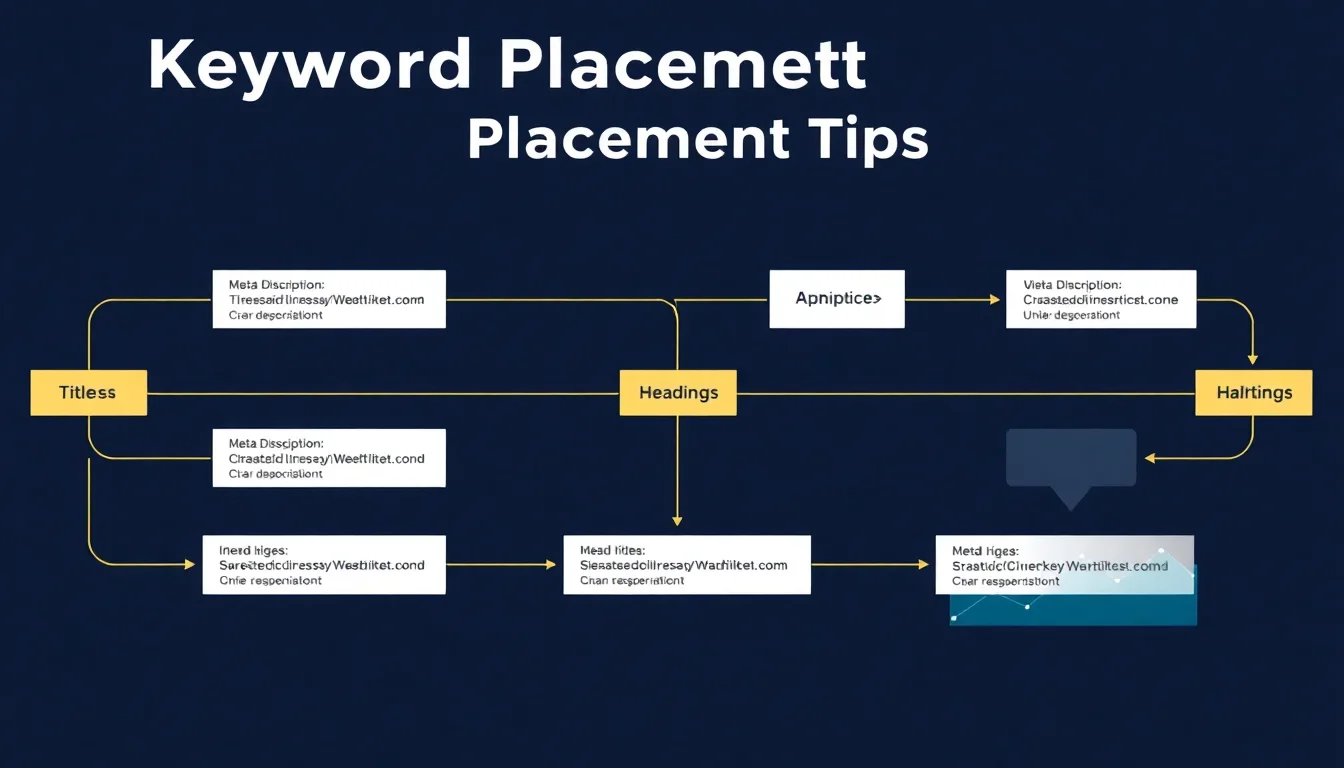
Place the primary keyword near the beginning of the title tag where possible and include it in one H2 or the main heading to reinforce relevance. Use secondary keywords in H2 and H3 to capture related search queries.
- Title tag: Include the primary keyword and an enticing value proposition within 50–60 characters.
- H1/H2: Use the primary keyword once in a natural, readable form.
- H3: Use variations and long-tail terms to cover subtopics and semantic breadth.
Keyword density and distribution throughout content
Distribute keywords naturally; target a keyword density of roughly 0.5%–1.5% for primary terms, with semantic variations used more frequently. Focus on context and readability rather than exact-match frequency.
- Include the primary keyword in the first 100–150 words.
- Use the primary keyword 2–4 times in a 1,000-word article and include 6–10 related terms.
- Place keywords in captions, lists, and emphasized text where relevant.
Using keywords in meta descriptions and URLs
Include the primary keyword in the URL slug and meta description to improve click-through relevance. Meta descriptions do not directly affect ranking but influence user behavior and snippet relevance.
- URL: Keep slugs short, hyphen-separated, and include the primary keyword near the start.
- Meta description: Use the primary keyword once and describe the value proposition in 120–155 characters.
Long-form content placement
For long-form pages, map keywords to sections and subsections. Use a content outline that assigns a primary keyword to the page and secondary keywords to subsections to prevent cannibalization and ensure coverage.
Key takeaway
Place primary keywords in titles, headings, URLs, and early content, and distribute semantic variations across subsections for comprehensive topical coverage.
Best Practices for Keyword Placement
Best practices combine user-focused writing with structured placement to satisfy both users and search algorithms. Prioritize clarity, relevance, and natural phrasing over exact-match repetition.
Optimize for users first
Write content that answers user intent clearly; use keywords to signal relevance rather than to force phrasing. Well-placed keywords enhance readability and comprehension.
How to avoid keyword stuffing
Avoid repeating exact-match keywords in unnatural ways. Review content for flow, remove redundant occurrences, and replace repeats with semantic synonyms and related phrases.
- Run a readability check and remove awkward sentences.
- Replace duplicate keywords with related entities and LSI terms.
- Use synonyms, plurals, and question forms to broaden reach.
Examples of effective keyword use
Example 1: Service page for managed hosting uses “managed WordPress hosting” in the title and header, then distributes “secure managed hosting”, “WordPress performance”, and feature-specific phrases across sections.
Example 2: Blog post targeting “how to optimise meta descriptions” includes the phrase in the title, the first paragraph, and an H2, then uses related queries such as “meta description best practices” in subsections.
Measurement and iteration
Track rankings, organic clicks, and CTR for pages after placement changes. Use A/B tests for title and meta variations, and monitor ranking movement with the same set of keywords for at least four to eight weeks.
Key takeaway
Prioritize user clarity, use natural phrasing, avoid stuffing, and iterate based on measurement data to refine placements continually.
Common Keyword Placement Mistakes
Common mistakes include keyword stuffing, placing keywords only in low-value locations, misaligning keywords with intent, and duplicative targeting that causes cannibalization.
Overview of what to avoid
Avoid exact-match repetition, keyword stuffing in metadata, and stuffing keywords into hidden or low-visibility elements. Do not place high-priority keywords on low-value landing pages that do not satisfy intent.
Case study: poor placement and correction
Case: An e-commerce category page used the primary keyword only in meta tags and repeated it heavily within product descriptions. Result: low rankings and poor CTR due to mismatch with transactional intent.
Correction steps: Move the primary keyword into the title and H1, optimize product titles for unique long-tail terms, add structured product data, and refine meta descriptions to target transactional intent explicitly.
How to detect and correct mistakes
- Audit pages for title, H1, URL, and first-paragraph keyword presence.
- Identify pages targeting the same keywords; consolidate or reassign targets to avoid cannibalization.
- Replace forced repetitions with semantic variations and expand content to address intent gaps.
Key takeaway
Detect placement errors via structured audits, reassign targets to resolve cannibalization, and align placements with user intent for improved performance.
The Role of Schema Markup in Keyword Placement
Schema markup provides structured context about page content and can improve how search engines interpret targeted keywords by connecting content entities to defined schema types.
What is schema markup?
Schema markup is structured data added to HTML to label content elements such as product, article, FAQ, and event. Markup communicates entity properties to search engines and can enable enhanced SERP features.
How schema aids keyword placement
Schema does not change keyword ranking directly but clarifies content purpose, which increases the likelihood that search engines will surface the page for relevant queries and display rich snippets that include the targeted keywords.
- Article schema: Signals title, author, and publish date for content pages where keywords target informational queries.
- Product schema: Aligns product names and features with transactional keywords used in e-commerce placements.
- FAQ schema: Highlights question-and-answer pairs containing long-tail and question-form keywords for potential rich results.
Examples of relevant schema types
Implement Article, FAQ, Product, HowTo, and BreadcrumbList schema types where appropriate to reinforce keyword-context mapping and improve snippet presentation. Learn more at Keyword Placement: Our Guide to Mastering Blogging SEO.
Key takeaway
Use schema to clarify content entities and to present targeted keywords within rich snippet contexts that support higher visibility and improved CTR. Read more at Effective Keyword Placement: Tips for Titles, Meta ….
Keyword placement tips: Tools and Resources for Keyword Research
Use established tools to gather volume, difficulty, SERP features, and intent signals and to audit existing placements across large site inventories. For details, see Keyword Placement Strategies That Improve SEO Rankings.
List of popular keyword research tools
- Ahrefs — Keyword Explorer, SERP analysis, and content gap identification.
- SEMrush — Keyword Magic Tool, competitive research, and keyword intent grouping.
- Google Keyword Planner — Volume and trend estimates for paid and organic planning.
- Google Search Console — Performance data, query impressions, and click metrics for live pages.
- AnswerThePublic — Question-based expansion and long-tail idea generation.
Comparison table of features and pricing
| Tool Name | Features | Pricing | Best For |
|---|---|---|---|
| Ahrefs | Keyword Explorer, Site Explorer, Content Gap | Tiered subscriptions starting from mid-range monthly plans | Competitive analysis and backlink-informed keyword strategy |
| SEMrush | Keyword Magic Tool, Topic Research, Position Tracking | Tiered subscriptions with seasonal discounts | Comprehensive keyword research and PPC/SEO integration |
| Google Keyword Planner | Search volume, forecast, and keyword suggestions | Free with Google Ads account | Baseline volume estimates and paid keyword planning |
| Google Search Console | Search performance, top queries, CTR, and impressions | Free | Monitoring real performance and optimizing placements on existing pages |
| AnswerThePublic | Question-based and prepositional keyword ideas | Free limited tier; paid Pro tier | Long-tail ideation and content topic expansion |
Practical use cases
Use Google Search Console to identify queries already driving impressions and then apply keyword placement updates to titles and H2s to improve CTR. Use Ahrefs or SEMrush to uncover competitor placements and content gaps for strategic targeting. Additional insights at Keyword Placement: Where Should You Put Keywords?.
Key takeaway
Combine authoritative research tools with performance data to choose, validate, and prioritize keyword placements at scale.
Conclusion and Next Steps
Apply the recommended placement strategies immediately: map primary keywords to titles, URLs, and first paragraphs; distribute secondary keywords to headings and subsections; and use schema to clarify content purpose. Audit existing pages to resolve cannibalization and align placements with intent.
Next steps: create a keyword map for priority pages, implement placement changes in a staging environment, and track progress using ranking and performance metrics over a 4–8 week period. Iterate based on CTR, impressions, and conversion metrics to optimize placements further.
Final key takeaway
Consistent, intent-aligned keyword placement across structural and content elements improves relevance, visibility, and user response. Prioritize placement in titles, headings, URLs, and early content while maintaining natural language and semantic breadth.
Sources & References
- Google Search Central — Guidance on page structure, titles, and meta descriptions
- Ahrefs — Research and documentation on keyword research and content gaps
- SEMrush — Insights on keyword intent and competitive analysis tools
- HubSpot Research — Studies on search behavior and content performance
Key takeaway
Address FAQs by answering directly, aligning placements with intent, and using documented processes to iterate and measure results consistently.
Apply these Keyword placement tips to your content workflow: map keywords to page structure, place primary terms in high-value elements, distribute semantic variants across sections, and measure performance using search analytics. Continuous auditing, schema use, and data-driven iteration will sustain ranking improvements and user engagement.