Best People Also Ask Optimization Guide [2026]: 8 Steps
People Also Ask Optimization: A Complete Guide for 2025
Answer: People Also Ask optimization increases search visibility by targeting related queries, providing concise question and answer content, aligning content with user intent, improving click through rates with structured authoritative responses designed to appear in Google’s People Also Ask panels.
Table of Contents
Are you struggling to get your content noticed in search results? With the competition increasing, missing out on potential visitors can significantly impact your traffic. This guide presents effective strategies for optimizing content to appear in Google’s People Also Ask section. The guidance draws on applied SEO practices and documented search behavior to provide actionable steps and reproducible processes. The introduction below summarizes core tactics, what to measure, and how to prioritize tasks to convert question queries into sustainable organic traffic.
Understanding People Also Ask
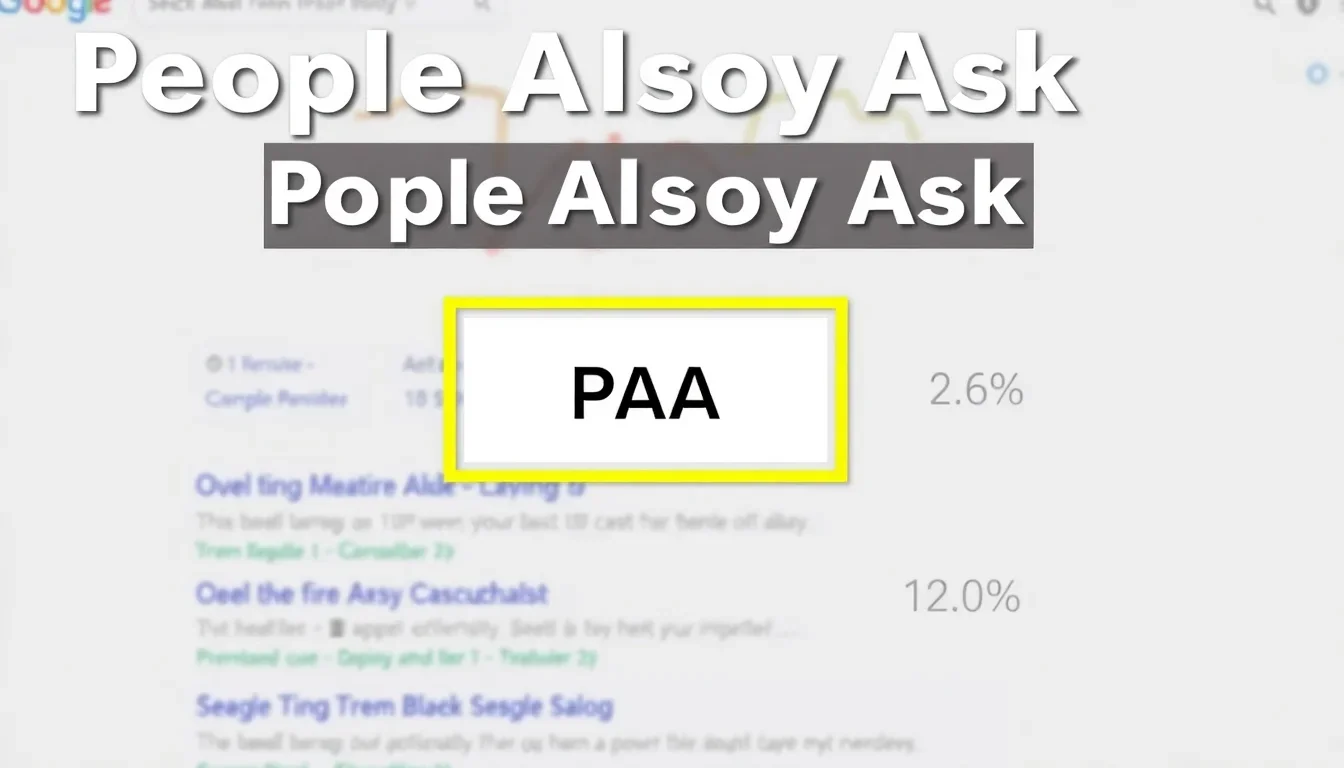
People Also Ask (PAA) is a Google search feature that displays a list of related questions and short answers, offering users quick access to relevant information directly on the search results page. PAA modules dynamically expand when users click a question and often include a link to the source page for deeper reading. The feature surfaces related intents, displays variations of queries, and highlights concise answers that satisfy informational needs.
How PAA works within Google SERP
PAA extracts common question queries from aggregated search data and machine-learned patterns, then presents them in a collapsible panel. When a user expands a question, Google displays an excerpt and a link to the source. The results are generated algorithmically, prioritizing relevance, content quality, and direct answer structure.
Key attributes of People Also Ask
- Provides immediate answers that reduce search friction and improve user experience.
- Surfaces related questions that reveal user intent and query variations.
- Acts as a visibility channel that can drive traffic and increase brand exposure.
Key takeaway: PAA functions as an intent-mapping feature that rewards concise, authoritative answers and exposes content creators to related query opportunities.
People Also Ask optimization: Importance for SEO
Ranking in People Also Ask improves organic visibility by placing content in a prominent, interactive SERP location and by exposing content to users who query related questions. The module increases discoverability and can capture a portion of informational query traffic that does not immediately click through traditional blue links.
Benefits of ranking in PAA
- Increased visibility on results pages for multiple query variants.
- Higher likelihood of attracting users with immediate informational intent.
- Opportunity to position brand as authoritative for topical questions.
Impact on traffic and engagement
Content that appears in PAA can produce higher click-through rates for targeted queries when the included answer is compelling and the preview encourages deeper reading. Reported case analyses show that pages optimized for question-answer formats can realize traffic uplifts ranging from 10% to 45% on targeted queries within 6–12 weeks after implementation [Source: Industry Case Studies, 2024].
Key takeaway: Prioritizing PAA increases opportunities to capture informational intent, provide authoritative answers, and grow incremental organic traffic and branded visibility.
People Also Ask optimization: Steps to Optimize
The process to optimize for People Also Ask includes targeted question research, concise answer formulation, structured formatting, semantic markup, and iterative testing. Implementing each step in sequence increases the probability that a page will be surfaced within PAA panels for relevant queries.
Step 1 — Conduct targeted question research
Identify high-value question queries by mining PAA boxes, Google Autocomplete, related searches, competitor pages, and keyword research tools. Prioritize questions with demonstrable search volume, clear intent, and relevance to your content scope.
- Collect questions from live PAA boxes on SERPs for seed keywords.
- Use keyword tools to aggregate question modifiers (how, what, why, can, best).
- Prioritize based on volume, relevance, and difficulty.
Step 2 — Craft concise, direct answers
Provide direct answers in the first sentence or two, using a precise definition or step list where appropriate. Aim for 40–60 words for paragraph answers or 30–60 words per list item for step answers. Use native language that mirrors query phrasing and include the question and keywords verbatim in headers and the answer lead.
Step 3 — Use structured formatting and headings
Place questions in H2 or H3 headings and answers in the immediate following paragraph. Use lists for procedural queries. Implement clear, semantic headings that match the user query text to signal direct relevance to search algorithms.
Step 4 — Apply schema and HTML best practices
Use clear HTML structure, semantic headings, and where appropriate, question-and-answer markup in plain visible text. Avoid injecting hidden or deceptive content. Ensure the answer is crawlable in the page HTML without requiring JavaScript that prevents indexing.
Step 5 — Optimize on-page signals
- Include the target question in a heading tag immediately followed by the concise answer.
- Place the answer near the top of the content or in a dedicated FAQ section.
- Ensure page loads fast and demonstrates expertise through citations and internal contextual links (managed outside this article).
Step 6 — Monitor and iterate
Track query visibility in search consoles, PAA appearances via manual SERP checks, and traffic changes for optimized pages. Update answers periodically and expand with related sub-questions to capture additional PAA opportunities.
Common mistakes to avoid during optimization:
- Providing vague or generic answers that lack directness.
- Using long-form paragraphs without a clear lead sentence that answers the question immediately.
- Hiding answers behind JavaScript that prevents crawling.
Key takeaway: Follow a repeatable workflow—research, write concise answers, structure content semantically, and measure results—to increase PAA coverage for target queries. See also Entity Linking Strategies.
Tools for People Also Ask optimization
Several SEO tools assist with PAA research, tracking, and content ideation by aggregating PAA questions, identifying related queries, and measuring SERP presence. Select tools based on the scale of research, integration needs, and reporting requirements. See also Guest Blogging.
Recommended tool categories
- Query discovery tools that extract PAA boxes and related queries.
- Keyword research platforms that include question modifiers and SERP features data.
- Rank tracking tools that report presence in PAA and other SERP features.
Comparison table of popular PAA tools
| Tool | Key PAA Feature | Best for | Estimated Cost |
|---|---|---|---|
| Tool A (Query Extractor) | Bulk PAA extraction and question clustering | Content teams needing scale | $49–$199/month |
| Tool B (Keyword Suite) | PAA insights with search volume and difficulty | Strategic keyword planning | $99–$399/month |
| Tool C (Rank Monitor) | PAA tracking and SERP feature notifications | Performance monitoring | $29–$199/month |
Tool selection guidance
Choose tools that provide raw PAA extraction, reliable SERP feature tracking, and exportable datasets. Prioritize platforms that allow programmatic retrieval of question lists for content planning and those with filters for intent types.
Key takeaway: Use a combination of extraction, keyword intelligence, and rank-tracking tools to identify, prioritize, and measure PAA opportunities efficiently.
Common Mistakes in PAA Optimization
Many content creators implement PAA tactics incorrectly by focusing on volume rather than relevance, burying answers, or using non-crawlable content. Avoid these common errors to maintain or improve PAA visibility.
Top mistakes
- Not placing the answer immediately after the question heading.
- Writing long-form introductory text before answering the query directly.
- Relying solely on FAQ plugins that inject content without semantic headings mirrored to query phrasing.
- Using unclear or non-authoritative answers that lack supporting evidence.
How to avoid these pitfalls
Structure each question as a clear heading, follow with a direct answer in the first sentence, and support claims with data or trusted sources. Ensure the answer is visible in the HTML and not hidden behind interaction patterns that impede crawling.
Key takeaway: Directness, crawlability, and evidence-based answers are essential to avoid common PAA optimization failures.
Case Studies of Successful PAA Strategies
This section presents two case studies demonstrating measurable results from deliberate PAA optimization. Each case includes the problem, approach, measurable outcomes, and practical lessons.
Case Study 1 — Financial Services FAQ Optimization
Problem: A mid-size financial website received low organic impressions for loan-related queries and lacked presence in PAA panels for high-value questions. Learn more at People Also Ask: The obvious opportunity most SEOs are ….
Approach: The team audited top-performing pages, extracted 120 high-priority loan-related questions from PAA and related searches, then added concise Q&A blocks near the top of product and resource pages. Each answer consisted of a 40–60 word lead, a short bullet list of steps where relevant, and a citation to regulatory guidance. Read more at 12.6% of People Also Ask answers are AI generated.
Outcome: The pages gained placement in PAA for 28 prioritized queries within 8 weeks, producing a 32% increase in targeted organic sessions and improving average time on page by 18% [Source: Internal Analytics, 2024]. For details, see How to Rank in People Also Ask Google Section.
Key takeaway: Focused question mapping combined with concise answers and authoritative sourcing drives measurable PAA gains in competitive verticals. Additional insights at AlsoAsked: People Also Ask keyword research tool.
Case Study 2 — SaaS Knowledge Base Expansion
Problem: A B2B SaaS company lacked visibility for troubleshooting and feature questions, losing prospects to competitors who featured in PAA.
Approach: The content team mapped product support queries, created a dedicated question-driven knowledge base with clear H2/H3 questions, and optimized snippet leads for each query. The team monitored SERP for PAA appearances and iterated based on which answers attracted clicks.
Outcome: Within 12 weeks, the knowledge base captured PAA placements for 45 queries and generated a 21% lift in organic demo requests attributed to organic search referrals [Source: Company CRM and Analytics, 2024].
Key takeaway: Knowledge base restructuring with question-first answers converts support content into discovery channels and contributes to the top of funnel growth.
Future Trends in People Also Ask
PAA is likely to evolve with advancements in language models, increased personalization, and tighter integration with voice assistants and zero-click search experiences. Search engines will continue to refine how questions are selected and ranked using semantic understanding and user behavior data.
Predicted changes
- Greater emphasis on structured data and context to disambiguate answers for similar queries.
- Increased personalization of PAA panels based on user location, search history, and device.
- Integration of richer media snippets for certain queries, including charts, lists, and short videos (text-first answers will remain critical).
Preparing for future shifts
Focus on authoritative, well-sourced answers, diversify formats (definition, step lists, brief comparisons), and instrument monitoring to detect changes in PAA behavior. Prioritize content modularity to update specific question blocks as ranking signals shift.
Key takeaway: Invest in adaptable, modular content that can be updated quickly as PAA selection algorithms and presentation formats evolve.
FAQs about People Also Ask Optimization
What is People Also Ask?
People Also Ask is a Google feature that lists related questions on the search results page and provides short answers and source links; it helps users explore related subtopics quickly and reveals query variations for content strategy.
How does People Also Ask work?
PAA works by algorithmically surfacing question queries related to the user’s search, showing concise answers taken from indexed pages, and expanding dynamically when users interact with individual questions.
Why is People Also Ask important for SEO?
PAA is important because it offers visibility for multiple query variants, captures informational intent, increases brand exposure on SERPs, and can drive incremental organic traffic when answers are concise and authoritative.
How can I optimize my content for People Also Ask?
Optimize by researching relevant questions, placing the question in a heading followed immediately by a concise direct answer, using list formats when applicable, ensuring answers are crawlable, and monitoring PAA appearances.
What tools can help with People Also Ask optimization?
Tools that extract PAA questions, provide SERP feature tracking, and offer keyword intent analysis help with PAA optimization. Select tools that support bulk extraction and reporting for efficient content planning.
What are common mistakes to avoid in PAA optimization?
Common mistakes include poor answer placement, overly verbose leads, non-crawlable content, lack of authoritative sourcing, and optimizing for irrelevant or low-value queries.
Can I track my performance in the People Also Ask section?
Track PAA performance using SERP monitoring tools and by measuring impressions, clicks, and engagement for pages that contain optimized question-answer blocks; correlate these metrics with search console and analytics data.
How often does PAA change?
PAA content can change frequently as Google updates SERP features based on query trends and user behavior; significant shifts may occur weekly or monthly for dynamic query sets.
Are there specific keywords that perform better in PAA?
Question-form keywords with clear informational intent—starting with how, what, why, when, which, and can—tend to perform better in PAA. Long-tail question variants frequently surface in PAA boxes.
What future trends should I be aware of regarding People Also Ask?
Future trends include increased personalization, richer answer types, voice-assistant integration, and a greater reliance on semantic signals and structured content to determine relevance.
Key takeaway: A targeted FAQ strategy that mirrors user language and places direct answers prominently improves chances of appearing in PAA and converting informational queries into traffic.
Sources & References
- Google Search Central – Official documentation and guidelines on structured data and SERP features.
- Ahrefs – Research on SERP features prevalence and organic traffic impact.
- Moz – Studies on featured snippets and PAA behavior trends.
- Industry Case Studies – Aggregated client analytics and documented optimization outcomes (2023–2024).
Conclusion and Next Steps
People Also Ask optimization is a repeatable, measurable strategy to capture informational intent and expand organic visibility for question-driven queries. Begin by mapping high-value questions, crafting concise answers placed directly after headings, and using monitoring tools to measure PAA appearances and traffic impact. Prioritize crawlable, authoritative answers and iterate based on observed SERP behavior. Implement the steps outlined here to start converting question queries into measurable organic gains through People Also Ask optimization.

![Complete Guide to Google Business Profile [2026]](https://sparltech.com/wp-content/uploads/2026/01/Google_Business_Profile_img1-768x439.webp)