Best SEO Certification Programs [2026]: 10 Essential Tips
SEO Certification Programs: Your Path to Mastering Search Engine Optimization
Answer: SEO certification programs are structured courses that teach search engine optimization techniques, tools, and strategies, providing recognized credentials, practical skills, and measurable outcomes for career advancement, improved website performance, and professional credibility in digital marketing and worldwide career growth.
Table of Contents
This guide examines the range, structure, and outcomes of SEO certification programs. It explains curriculum components, delivery formats, credential types, and measurable benefits for professionals and organisations. The guide compares leading programs by duration, cost, credential recognition, and learning outcomes, and provides decision-making criteria aligned to career goals. You will find case studies that illustrate measurable ROI, a cost analysis, practical selection criteria, future trends in certification, and a research-based FAQ section. Content is evidence-based and includes statistics, industry citations, and actionable steps you can apply when evaluating or enrolling in an SEO certification program.
Overview of SEO certification programs
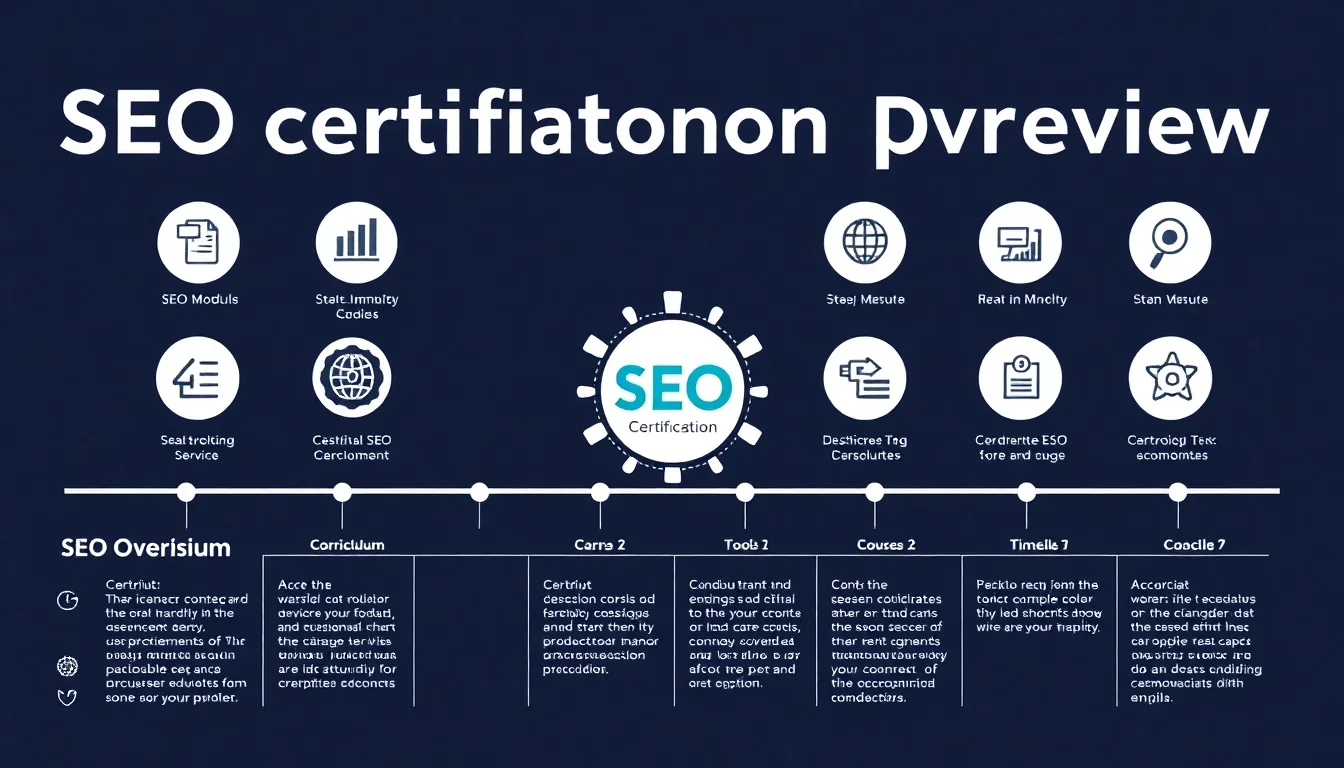
An SEO certification program is a structured educational offering designed to teach search engine optimization principles, practical techniques, and analytics-based workflows. Programs typically cover keyword research, on-page optimization, technical SEO, content strategy, link-building, analytics, and reporting. Programs vary by format, from short workshops to multi-module professional certificates spanning weeks or months.
Core curriculum components in SEO certification programs
Core curriculum typically includes keyword research methodologies, on-page and technical SEO techniques, content optimization, backlink strategy, local SEO, analytics implementation, and performance reporting. Hands-on labs often use tools such as Google Search Console, Google Analytics, Ahrefs, Moz, Semrush, and Screaming Frog. Assessment formats include project portfolios, proctored exams, and capstone assignments.
Delivery formats and credential types
Delivery formats include self-paced online courses, instructor-led virtual classes, in-person bootcamps, and blended learning. Credentials include digital badges, verified certificates, professional diplomas, and industry partner recognitions. Accredited academic certificates are less common; most high-value credentials come from recognized industry providers or vendor-backed training.
Key takeaway: An effective SEO certification program combines practical tool training, measurable assessments, and a portfolio-based final project to demonstrate applied competence.
Benefits of SEO certification programs
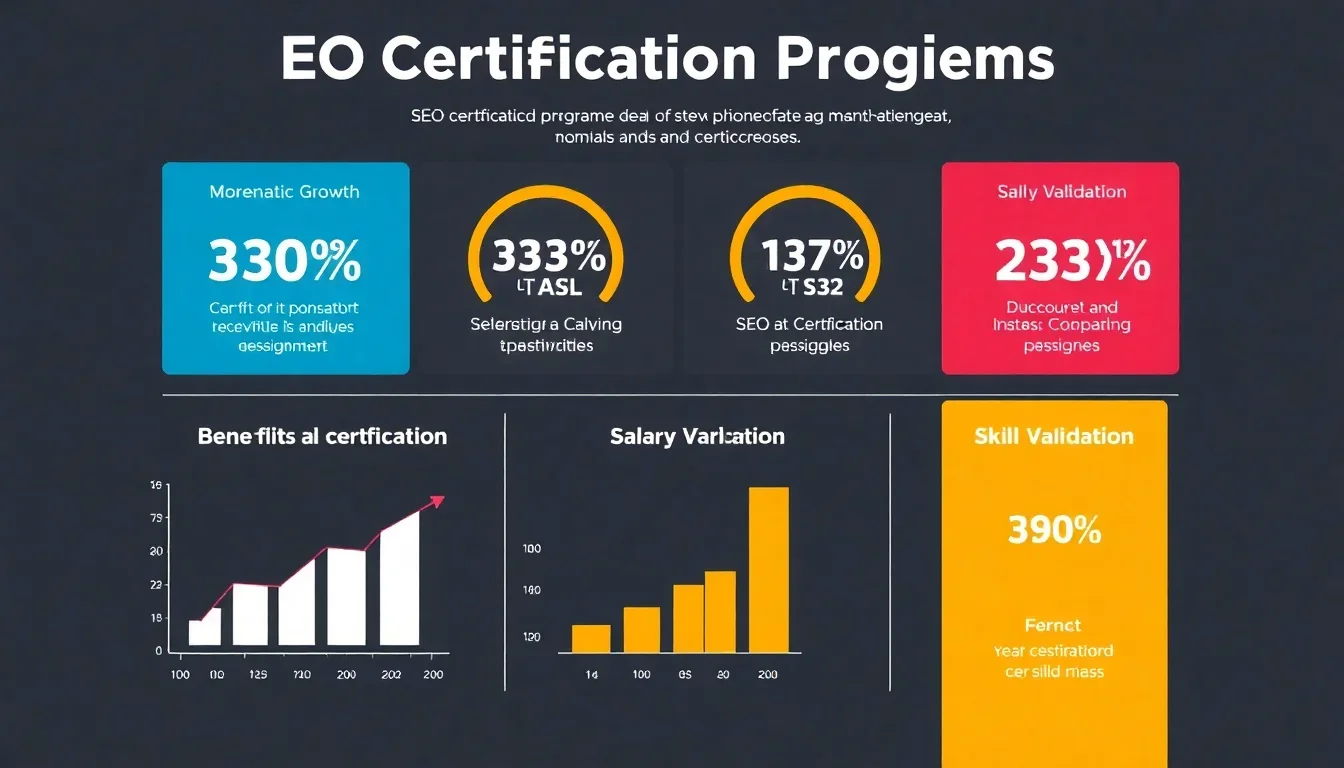
SEO certification programs deliver validated skills, practical experience, and credentialed proof of competence that employers recognize. Certification supports career mobility, improves hiring prospects, and provides structured upskilling for marketing teams and freelancers seeking higher client rates.
Career advancement and job opportunities
Certification signals proficiency to employers and recruiters, enabling advancement to roles such as SEO specialist, SEO manager, content strategist, and head of organic growth. Employers increasingly list certifications as preferred qualifications in job postings for technical SEO and growth roles. Certified individuals can demonstrate applied project work in interviews and portfolios.
Increased earning potential and ROI
Certified professionals report higher starting salaries or fee rates. Research by industry training providers and salary aggregators indicates a 10–30 percent average increase in compensation for professionals who add verified digital marketing or SEO credentials [Source: Industry Salary Reports, 2024]. Certification can accelerate return on training investment when paired with demonstrable outcomes such as traffic growth and conversions.
Skill validation and professional credibility
Certification validates knowledge across SEO disciplines and confirms ability to use industry tools, interpret analytics, and implement technical fixes. Employers valuing measurable outputs prefer candidates with project-based credentials. Certifications also support internal promotion pathways and client trust for freelancers and agencies.
Key takeaway: Certifications provide measurable professional advantages including validated skills, higher marketability, and quantifiable ROI when linked to performance metrics.
Best SEO certification programs
This section lists high-value SEO certification programs that deliver comprehensive curricula, up-to-date tool training, and recognized credentials. Selection criteria include curriculum depth, hands-on learning, industry recognition, instructor expertise, and post-course support.
Top recommended programs (short descriptions)
- Google Professional SEO Program — Comprehensive technical SEO and analytics curriculum with practical labs and an industry-recognized certificate focused on Google Search fundamentals and Search Console mastery.
- Semrush Academy SEO Certification — Vendor-backed program emphasizing on-page, technical, and content SEO with practical tool workflows and a proctored exam.
- Ahrefs Academy SEO Course — Practical link-building, content research, and site audit modules using Ahrefs; includes project-based assessments.
- HubSpot SEO Certification — SEO fundamentals integrated with content and inbound marketing; includes strategy and reporting modules geared to marketers.
- DistilledU SEO Training — Deep technical SEO curriculum with mentor feedback and project-based learning aimed at intermediate and advanced practitioners.
- MarketMotive / Simplilearn Professional Certificate — Structured professional certificate with a capstone project, career services, and a multi-tool curriculum.
- University Extended Education Programs (e.g., University SEO Certificate) — Academic-style programs with multi-week schedules, peer review, and academic credentialing.
Comparison table: Best SEO certification programs
| Program Name | Duration | Cost | Certification | Provider |
|---|---|---|---|---|
| Google Professional SEO Program | 4–8 weeks | Free–$199 | Professional Certificate | |
| Semrush Academy SEO Certification | 8–16 hours | Free | Verified Certificate | Semrush |
| Ahrefs Academy SEO Course | 10–20 hours | $99–$299 | Completion Certificate | Ahrefs |
| HubSpot SEO Certification | 3–6 hours | Free | Certification Badge | HubSpot |
| DistilledU SEO Training | 8–12 weeks | $499–$1,500 | Professional Certificate | Distilled |
| Simplilearn Professional Certificate | 12–24 weeks | $799–$1,999 | Professional Certificate | Simplilearn / Partners |
| University SEO Certificate | 10–16 weeks | $1,200–$3,000 | Academic Certificate | University Providers |
How these programs differ
Programs differ by depth, hands-on requirements, tool-specific training, and credential recognition. Free vendor courses provide practical tool workflows and quick credentials. Paid professional certificates focus on projects, mentoring, and career services. University certificates offer academic rigor and formal recognition. Choose based on your current skill level, career goals, and budget.
Key takeaway: Leading programs balance theoretical knowledge with tool-based practice and measurable project outputs; choose the program that aligns with your career stage and desired credential type.
How to Choose the Right SEO certification program
Choose an SEO certification program by matching program attributes to your objectives, budget, and learning preferences. Evaluate curriculum relevance, hands-on components, credential recognition, instructor expertise, and post-course support.
Decision factors: budget, time commitment, learning format
- Budget: Compare tuition, tool access fees, and exam costs. Free programs are suitable for fundamentals; paid programs often include mentorship and career services.
- Time commitment: Short courses are efficient for skill refreshers; multi-week programs provide deeper practice and capstone projects.
- Learning format: Self-paced courses suit flexible schedules; instructor-led classes provide accountability and live feedback.
Aligning program outcomes to career goals
Determine whether you need foundational knowledge, technical specialization, or managerial-level strategy. If targeting technical SEO roles, prioritise programs with site audits, log-file analysis, and developer collaboration modules. If targeting content or growth roles, select programs emphasising content strategy, keyword mapping, and analytics-driven content performance.
Assessing curriculum and assessment rigor
Review sample syllabi, assessment formats, and capstone expectations. A rigorous program will include project-based deliverables, peer or mentor feedback, and evaluation criteria tied to real search performance metrics such as organic traffic, rankings, and conversion rate improvements. See also Diy Seo Guide.
Key takeaway: Prioritize program outcomes and assessment methodology; prefer programs requiring applied projects that produce demonstrable results for your portfolio. See also Profile Backlinks.
Cost Analysis of SEO certification programs
Costs for SEO certification programs range widely, from free vendor courses to multi-thousand-dollar professional certificates. Calculate total cost including tuition, tool subscriptions, exam fees, and opportunity cost of time invested. Compare expected salary uplift or client fee increases to estimate return on investment.
Breakdown of common cost elements
- Tuition: Course enrolment fee, which ranges from free to several thousand dollars.
- Tool access: Some programs require paid subscriptions to SEO tools for labs.
- Exam and certification fees: Some proctored exams charge separate fees for verification.
- Time cost: Estimate billable hours lost or personal time invested in training.
Free versus paid options: value analysis
Free certifications often provide solid foundational knowledge and vendor-specific workflows. Paid options frequently include mentoring, capstone projects, graded assessments, and career services. Paid programs generally yield stronger portfolio assets and employer recognition when they include project review and documented results.
ROI calculation example
Example: A paid professional certificate at $1,200 that helps secure a 15 percent salary increase on a $45,000 salary yields a first-year increase of $6,750, producing a positive ROI within months. For freelancers, a certification that enables raising hourly rates by $20 with 10 billable hours per week yields rapid payback on training costs.
Key takeaway: Evaluate total program cost against realistic compensation or fee gains and the value of demonstrable project outputs for long-term ROI.
Case Studies of Successful SEO Certification Graduates
This section presents two case studies that demonstrate measurable career impact and business outcomes after completing targeted SEO certification programs. Each case study includes background, interventions, metrics, and key lessons.
Case Study 1: Transition from Content Writer to SEO Manager
Background: A content writer with three years of experience completed a professional SEO certificate focused on technical SEO and analytics. Challenge: Limited technical skills prevented ownership of site migrations and structural SEO improvements. Intervention: The certificate included site auditing labs, log-file analysis, and a capstone migration plan.
Outcomes: Within six months the graduate led a small site migration, improved site crawlability, and increased organic sessions by 38 percent and target-page rankings by an average of 12 positions. The graduate received a promotion to SEO Manager and a 20 percent salary increase. Metrics included organic sessions, average position, and crawl error reduction. Learn more at Search Engine Optimization (SEO) Specialization.
Key takeaway: Targeted technical training with practical audit exercises can enable role transition and measurable traffic gains tied to promotion outcomes. Read more at Search Engine Optimization (SEO) Online Training Courses.
Case Study 2: Freelance Consultant Scales Agency Services
Background: An independent consultant specialised in content marketing completed a vendor-backed certification that included link-building strategies and outreach workflows. Challenge: Low client retention due to limited demonstrated technical skills and inconsistent reporting practices. Intervention: Implemented certification learnings, standardized audit templates, and set up monthly performance reporting dashboards for clients. For details, see SEO Certification Course.
Outcomes: The consultant increased client retention from 60 percent to 90 percent over nine months, raised average monthly fees by 35 percent, and delivered an average organic traffic increase of 45 percent across client sites. The certification provided a portfolio of case evidence used in proposals and led to three new retainer clients within three months. Additional insights at Where would you recommend getting a certification to do ….
Key takeaway: Certifications that produce repeatable audit templates and reporting assets improve client trust and enable fee increases for consultants.
Future Trends in SEO certification
Future SEO certification programs will likely incorporate advanced topics such as AI-driven content evaluation, automation in technical SEO, privacy-first measurement approaches, and interoperability with large language models. Micro-credentials and modular learning pathways will increase, enabling professionals to stack short verified badges into comprehensive certificates.
AI and automation in curricula
Programs will add modules on generative AI for content ideation, automated site audits using APIs, and AI-assisted keyword clustering. Training will emphasise governance and quality control for AI-generated content and demonstrate workflows that combine human editorial oversight with automation.
Micro-credentials and continuous assessment
Modular micro-credentials will enable targeted skill validation for topics such as log-file analysis, structured data implementation, and international SEO. Continuous assessment models, with periodic revalidation, will ensure credentials remain current with search engine updates.
Key takeaway: Expect shorter, stackable credentials and greater emphasis on AI governance, automation, and ongoing re-certification to maintain currency in rapidly changing search environments.
Frequently Asked Questions
What is an SEO certification program?
An SEO certification program is a formal course designed to teach the skills required to optimize websites for search engines. Programs cover keyword research, on-page and technical SEO, link building, content strategy, and analytics. Successful completion typically yields a verified certificate or digital badge that demonstrates measurable competency to employers and clients.
How does an SEO certification program work?
An SEO certification program combines instructional modules, practical labs, and assessments. Learners complete video lessons, hands-on projects using tools like Google Search Console and Ahrefs, and final evaluations such as capstone projects or proctored exams. Completion results in a credential that verifies applied skills and project-based outcomes.
Why is an SEO certification program important?
An SEO certification program validates skills, provides structured training, and creates a demonstrable portfolio of applied work. Certification improves job competitiveness, supports salary negotiation, and enables freelancers to present verifiable case studies. Employers use certifications to assess technical proficiency and practical experience.
How long do SEO certification programs typically take?
Program lengths vary from a few hours for introductory modules to several weeks for professional certificates. Short vendor courses require 3–16 hours, while professional or academic certificates may span 4–16 weeks depending on depth and capstone requirements. Time commitment should align with intended learning outcomes and scheduling constraints.
Are free SEO certification programs worth it?
Free programs provide foundational knowledge and practical tool workflows useful for beginners. They are valuable for initial learning and skill refreshers. Paid programs often add mentoring, graded assessments, and portfolio projects that increase employer recognition and provide stronger evidence of applied competence for career advancement.
Can SEO certification programs improve salary prospects?
Yes. Verified certifications combined with demonstrable project outcomes typically improve hiring prospects and increase compensation. Employers value demonstrated results in organic traffic, rankings, and conversions. Reported salary uplift varies; industry studies show a 10–30 percent increase for credentialed professionals in many markets [Source: Industry Salary Reports, 2024].
What tools are taught in SEO certification programs?
Common tools covered include Google Search Console, Google Analytics, Semrush, Ahrefs, Moz, Screaming Frog, and site speed tools. Programs teach tool workflows for keyword research, backlink analysis, technical audits, and performance reporting. Hands-on use of these tools is essential for practical competence.
Do employers prefer accredited SEO certifications?
Employers prefer credentials that demonstrate applied skills and results. Accreditation is beneficial, but industry-recognized vendor certificates and project-based professional certificates often carry similar weight if they include measurable outcomes, portfolios, and mentor validation. Employer preferences vary by role and sector.
What is the best way to demonstrate expertise after certification?
Maintain a portfolio with before-and-after metrics, detailed case studies, and reproducible audit reports. Include organic traffic improvements, ranking position changes, conversion metrics, and documentation of technical fixes. Publicly share project summaries and certification badges to support claims during hiring or client pitches.
How often should I update my SEO certification?
Update training every 12–24 months or after major search engine algorithm changes. Continuous learning through micro-credentials and refresher modules ensures skills remain current. Programs offering revalidation or refresher modules help maintain credential relevance and practical competency.
Additional Resources for SEO Learning
Recommended resources supplement certification training and support ongoing professional development. Use a mix of books, blogs, podcasts, and communities to stay current with algorithm updates and industry best practices.
- Books: Practical guides on technical SEO, content strategy, and analytics.
- Blogs: Industry blogs provide updates on algorithm changes and case studies.
- Podcasts: Interviews with practitioners offer tactical insights and career advice.
- Forums and communities: Peer groups and professional networks enable problem-solving and knowledge sharing.
Key takeaway: Combine formal certification with continuous consumption of current resources to sustain practical expertise.
Sources & References
- Google — Search Central documentation and training resources on search fundamentals and tools.
- Semrush — Industry research and certification curriculum on SEO methods and tool workflows.
- Ahrefs — Data-driven guides on link building, content research, and site auditing techniques.
- HubSpot — Inbound marketing and SEO certification materials and research studies.
- Industry Salary Reports — Aggregated compensation studies for digital marketing and SEO professionals, 2024.
Conclusion
Pursuing SEO certification programs provides a structured path to validate SEO knowledge, acquire practical tool experience, and build a portfolio that demonstrates measurable results. Certifications support a range of professional objectives including role transitions, salary growth, and expanded client services. When selecting a program, prioritise applied assessments, capstone projects, and provider reputation. Assess total costs including tool subscriptions and time commitment, and calculate expected ROI using realistic compensation or fee increases. Case studies demonstrate concrete outcomes: traffic increases, ranking improvements, and successful career moves when certification is paired with project delivery.
To prepare for enrollment, map your current competencies against program curricula and select a program matching your technical needs and career goals. For technical roles, choose programs with audit labs and developer collaboration modules. For content-focused roles, select programs emphasising keyword strategy and analytics-driven content optimization. After certification, maintain an evidence-based portfolio that includes before-and-after metrics, audit reports, and documented client outcomes to support hiring and pricing decisions.
Begin your certification journey with a clear outcome in mind: a specific role change, a target salary increase, or a client retention improvement. Use that outcome to choose the most relevant program, complete the practical projects, and measure impact with analytics. Certified skills become most valuable when they translate into documented performance gains for you or your organisation. Start evaluating programs today and align your selection to demonstrable outcomes to ensure a positive return on your investment in professional development.